

Let's eat cake! | 4. Carrying Capacity and "Community Resilience"

The Reindeer of St. Matthew’s Island
The story of St. Matthew’s Island is often cited as a classic example of carrying capacity, population dynamics, overshoot and collapse.
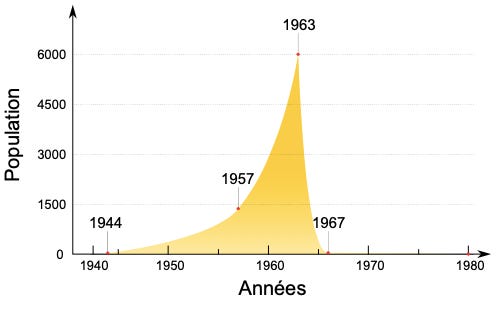
1944 - During World War II, the US Coast Guard sets up a station on a remote island off the coast of Alaska. It’s 138 square miles. They release 29 reindeer onto it as a backup food source for the men working there… The men wrap up their work there and abandon the island, without hunting any reindeer. There are no predators on the island. Lichen (symbiotic fungi + algae) grew in “mats 4 inches thick”.
1957 - Dave Klein, working for the US Fish and Wildlife Service, visits the island. There are now 1,350 reindeer, “most of which were fat and in excellent shape. Klein noticed that reindeer had trampled and overgrazed some lichen mats.”
1963 - 6,000 reindeer. “Klein noted the animals’ body size had decreased since his last visit, as had the ratio of yearling reindeer to adults.”
1964 - “A series of winter cyclones comparable in intensity to a Category 2 hurricane… brought much heavier than normal snowfall, stronger winds, and lower temperatures.” … But even if the storms hadn’t hit, the lichen had a set rate at which it could grow back, to continuously feed the deer.
1966 - 42 reindeer and lots of skeletons. 41 female, 1 male abnormal antlers, likely sterile.
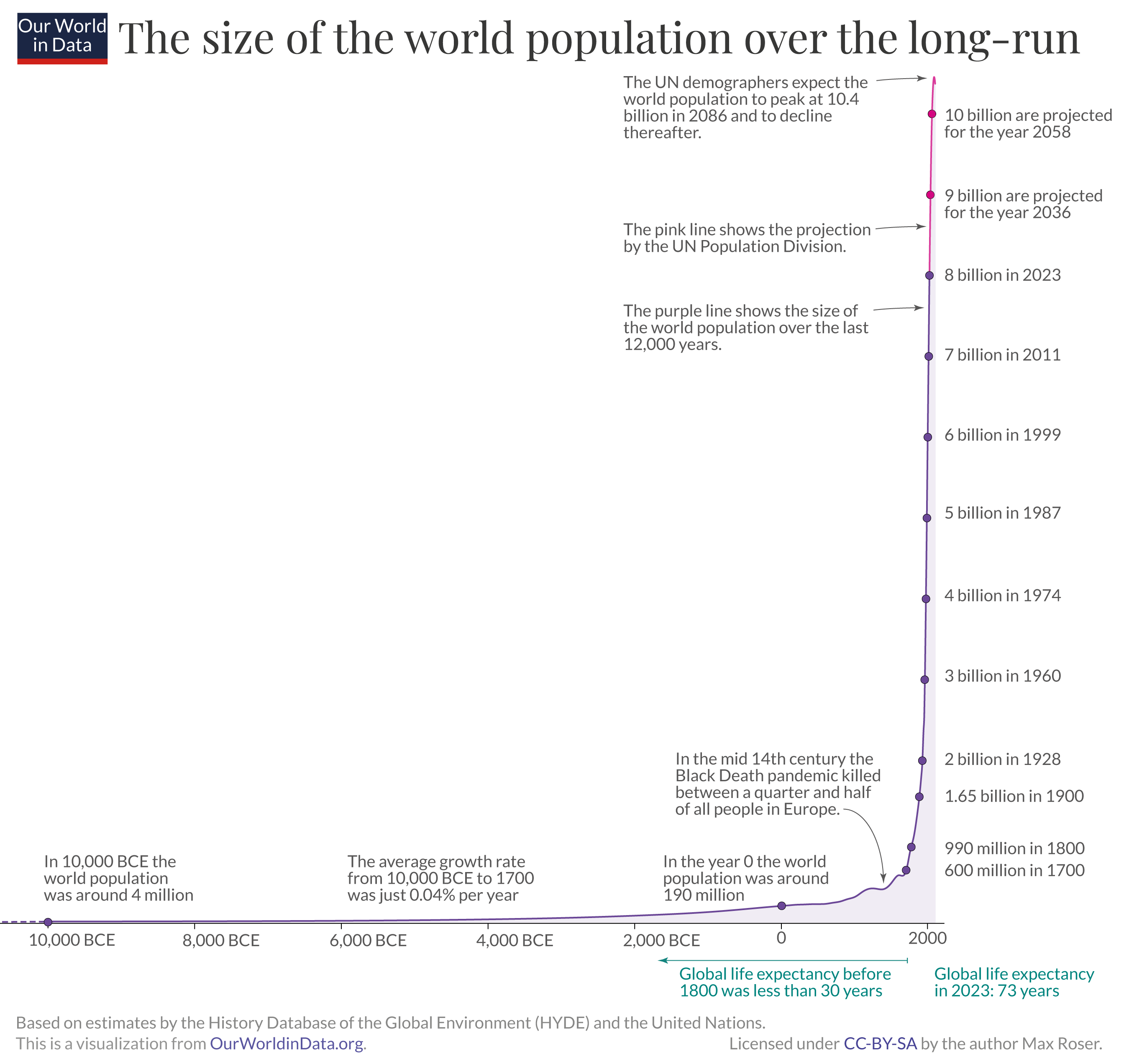
The human population hinges upward slightly when Earth entered the Holocene, and dramatically as empires expanded into “virgin” land and discovered oil. As my previous post noted, we’re now losing all of those advantages.

The Fate(s) of Pickle Island
As I described in Part 1 of this series, my inspiration for this was the fairly widespread blindness to (what I anticipate will be) an end to this brief, strange period when some Homo sapiens could rely on complex coordination and long-distance supply chains to meet essential needs. In the future, communities will either accomplish this at a local or bioregional scale, or they wont meet those needs.
Here, I’ll present three versions of a fictional Pickle Island.
This following scenarios aren’t so far-fetched:
In Alaska: A real place relies for supply deliveries on ice roads that are now melting. And will they really finish the all-weather roads that the article mentions? And as diesel becomes scarce, will any be allocated to the trucks that drive that route? (The article features a “Pickle Lake”, and given that “a pickle” is synonymous with a predicament and just sounds funny, I’m rolling with it.)
In Bolivia: The country has been experiencing a diesel supply shortage since at least 2024. The fuel crunch stifled “everything from the operation of tractors to the sourcing of machinery parts” and “prevent[ed] farmers from getting their produce to distribution centers and markets”. Protesters marched, shouting “Everything is expensive!” and demanding a remedy. Their Economy Minister assured citizens that “Diesel sales are in the process of returning to normal” … By 2025, farmers were still hurting for diesel, and then leadership had scrapped fuel subsidies, which led diesel prices to more-than-double. Cue transportation strike.
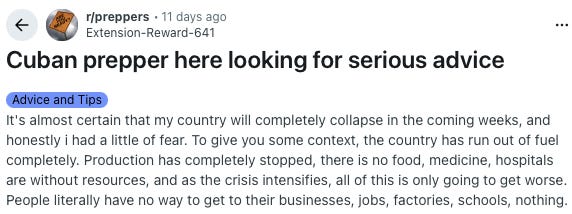
In Cuba: Provinces outside the capital have electricity for only 4 hours per day. “To buy gasoline, people have to use an app to sign up for an appointment... One resident of Havana … joined the queue three months ago, and is now No. 5,052 in line.” Due to fuel shortages, trash pick-up is sporadic, so rotting food is accumulating curbside,1 so mosquitos2 (and mosquito-borne disease) are spreading. For medications, if you don’t have contacts abroad, you can’t get any. Grocery items are too expensive to afford on a typical income. Cubans could stretch rations for only 5 days per week, and now, government ration stores rarely even have food.
Pickle Island | Version 1: Industrialism Forever!
We start with 10 Boomers and 20 Millennials. They move to an island. Food comes on a diesel-powered boat. Some academics and bloggers from the outside world warn of worsening resource decline and supply chain disruptions, but the Pickletons ignore this crazy talk. Dramatic things like that just don’t happen! They focus on their careers and pre-existing hobbies (cycling! photography! stand-up comedy!) and personal life goals, including parenting, which can be really time- and energy-consuming. The 20 Millennials couple up and each pair has 2 babies. Then the food deliveries get cut off. (So does internet too, let’s say, so they can’t look up foraging guides.) The Pickletons stare at their lawns and starve.
Final tally:
Demand = 10 + 20 + 20 = 50 humans (granted, some have temporarily lower calorie requirements)
Supply = 0 (I suppose the unit of measure here is “minimum continuous calorie supply to keep 1 human alive indefinitely”)
Pickle Island | Version 2: Low-Effort Collapse Model
Same 10 Boomers and 20 Millennials. This time, they’re thinking about collapse but working with a low-effort model.
Based on a recent post from The People’s Paper, “You’re Prepping for the Wrong Disaster”, these people are prepping for the right disaster. Many have attended Kollapscamp and are therefore extra confident about their answers to “What’s happening? Why? What lies ahead?”
They hold a weekly device-free potluck, swap thrifted clothes, learn carpentry, host repair cafés and mending circles, and frequently pause to reflect on their reverence for the more-than-human-world. In total, they conceive fewer babies, because they’re worried about the future and reject the pronatalist agenda of the baby-shower-industrial complex. A few garden, but they order seeds from catalogs instead of saving from their own yields, and therefore don’t think to strategize against inbreeding depression. Everyone keeps their homes stocked with several weeks’ worth of food in case of an emergency, because they’re smarter than those climate change-denying fools! Then, food deliveries stop.
Final tally:
Demand = 10 + 20 + 10 = 40.
Supply = 2. (Only cultivated food counts. The “imported” canned food isn’t a continuous food source. It’s a stock, not a flow.)
Pickle Island | Version 3: Deeply Collapse-Aware
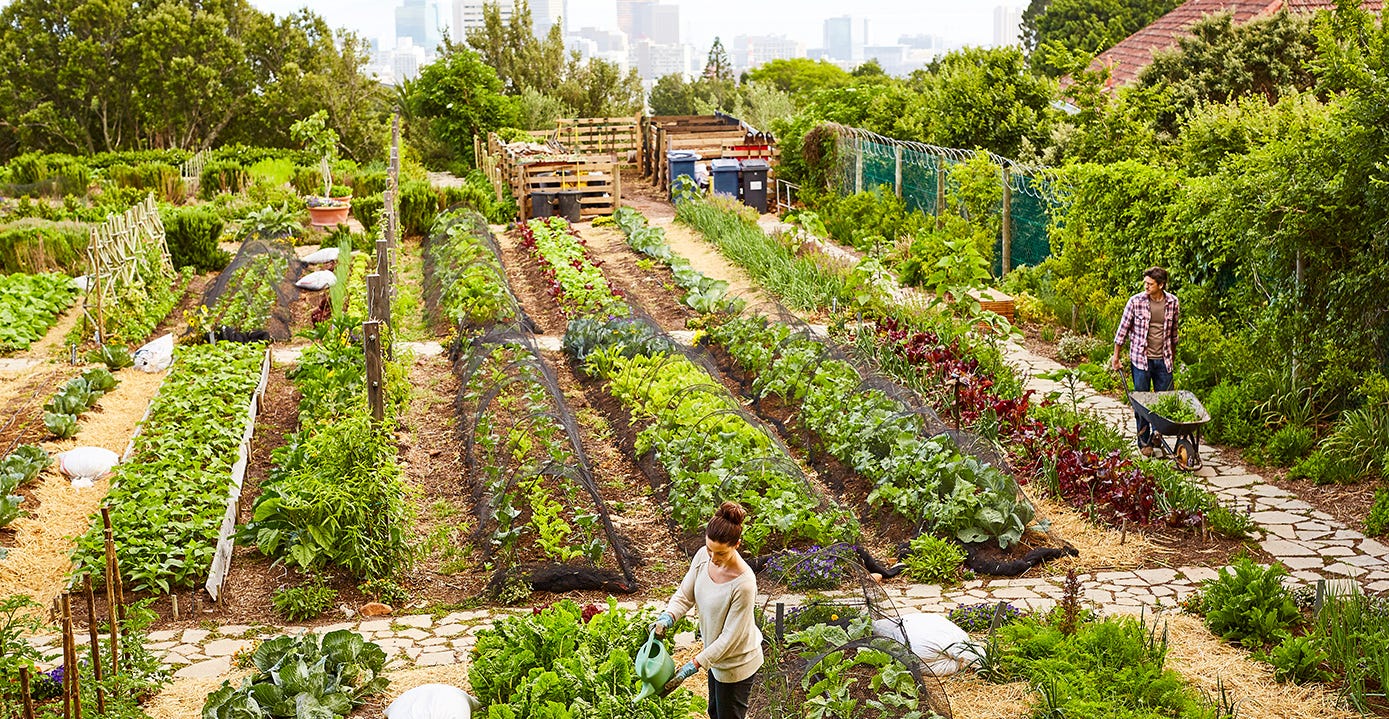
One more time! 10 Boomers and 20 Millennials. They detect the signal through the noise, and they put practicality before ideology, cultural norms and unskillful attachments. They resolve the devote their time and energy strategically. They aren’t expert gardeners etc.3, so they can’t make a sudden flip to collective self-sufficiency. They continue to work their remote jobs and exchange their income for the food that comes on the boat, but they know they can’t trust it forever, so they don’t lean in too hard professionally. They set a boundary of 40 hours/week of work in the formal economy, even though it means that a mainland colleague gets the promotion instead – which brings feelings of disappointment and frustration, and maybe judgement from others. (“Everyone else out there is fulfilling their potential while I’m becoming a nobody!”) By ditching (or pausing) some activities that now feel less relevant, like finishing a giant jigsaw puzzle or planning a month-long trip to a distant destination, they carve out more time for skill-building. After everyone on the island discusses population dynamics’ impacts on all island inhabitants and the group reaches consensus, a few couples have kids. When the food deliveries stop, they’ve worked up to successfully farming multiple acres, although ongoing climate destabilization makes it more challenging.
Demand = 10 + 20 + 4 = 34.
Supply = 25…. or anything >0 and <33.
But at least, since they spent their spare bandwidth on learning to source food, the disparity is Demand 35 / Supply 15 … anything is better than Demand 40 / Supply 0.
Pickle Island: Remarks
Skilled Labor
The St. Matthew’s analogy isn’t a perfect parallel to the situation that civilization members face because, as I laid out in the post where I proposed this term, they rely on agriculture - on making food happen, rather than making do with what’s automatically there, as many animals do.
Deer have foraging skills. Aspiring crop-eaters would need gardening/farming skills. The unspoken assumption behind carrying capacity calculations is that the creature doing the eating possesses the relevant SKILLS, EQUIPMENT, SUPPLIES and SYSTEMS to make it happen.
“Relevant Radius”
Since this story involved an island, it was easy to determine the headcount and acreage that they had to work with, and what the resultant Demand and Supply were. I reality, things are fraying and flickering. We can know that everyone’s radius for sourcing food will be shrinking over time, but I like to use the phrase “relevant radius” as a placeholder for whatever it might be, precisely, in any give year.

Courage Doesn’t Always Get You A Lollipop
I hesitate to pitch collapse-awareness on the promise that it’s the ticket to okayness. That’s why, in Version 3 of Pickle Island, I still had Demand exceeding Supply. Face reality because you appreciate that maturity is its own reward.
Self-Sufficiency As Protection Against Exploitation
I could describe a fourth Pickle Island scenario where residents lose access to learning resources, deliveries decline and an outside entity offers, “Come work in our camps! Yes they suck but at least there’s someone to provide farming ‘instruction’!” If no one on Pickle Island has already started learning to meet essential needs (who can then also act as a teacher) or if the student:teacher ratio is 39:1, residents might feel more pressure to take that deal than if they were really getting a handle on it in advance. It isn’t necessarily life-or-death, but the difference between more or less misery.
It’s worth considering:
Which factors best explain why Havanans are letting food scraps rot on the street, where they’ll stink and attract disease-spreading insects and rodents, rather than composting them into a safe, fertile garden amendment? Select all that apply.
no one in Havana knows about composting
some people know how to compost but no one is listening to them
the neighborhoods lack existing infrastructure/systems to support food scrap collection
after meeting daily demands to keep a roof overhead and food on table, residents lack bandwidth to make extra efforts
with what little spare bandwidth that they have, people are pursuing independent goals; bottom-up coordination and prioritization are alluding them
they didn’t spend enough time expressing their feelings and analyzing each others’ analyses
Based on your answer to (1) what can you extrapolate about what is likely to happen in Havana when toilets stop flushing? What can you extrapolate about your neighborhood in a future without trash pickup and flush toilets? Do y’all possess an advantage that would make this go much differently in your case?
Mosquitos don’t eat food scraps, but the stagnant liquid of decomposing food waste provides breeding habitat.
Livestock-keepers, foragers, hunters
Interesting read in the reddit link about Cuba. My heart goes out to them .
How long can altruism and solidarity continue with a sustained collapse scenario? Lots of accounts tell of a coming together socially after disaster strikes (or a narcissist president) but food, medicine, etc are forthcoming soon after.
It's not good anthropology but Colin Turnbull's account of the Ik people should sound some warnings about assuming things.
Memories are short, baselines shift.
Knowledge, a flexible mental state, good social connections and not sticking out are more important than how many tins of food you have.
Thanks Andrea, ugly times ahead. I would change one word in this sentence - "my inspiration for this was the fairly widespread blindness to" - fairly should be very IMO.
A typo here? I reality, things are fraying and flickering.
Hang in there...