

(apo)calyptic voices | 4. The "Gets It" Divide
This series covers instances where people use terms like “collapse” and “predicament” but don’t grasp (or, therefore, convey) the full, accurate, detailed message.
If you haven’t thoroughly understood the answers to “What’s happening?” and “Why?” (which I cover briefly here and at length in the essays on my main page), you’ll have flawed thoughts on “What lies ahead?” and on what kinds of outcomes we might expect from various efforts.
(And yes, there are parallels below to narrow-boundary versus wide-boundary analysis, and to Bright Green versus Deep Green environmentalism.)

Cause of “doom”
LOW EFFORT:
Bad guys are ruining everything! Republicans, capitalism and fossil fuels are the roots of our problems. Evil people are driving our bus toward a cliff, and if we just take control of the steering wheel and convert the bus to run on electricity, and fix a few other things, then we’ll all be okay.
DILIGENT:
Hanlon’s Razor sums up the reality: “Never attribute to [individual] malice that which can be adequately explained by [collective] stupidity.”
Civilizations have two features that both distinguish them and spell their demise: “no-chill agriculture” + infrastructure made from inorganic materials. With no-chill agriculture, humans collectively claim more and more of Earth’s finite surface area, thereby consuming more calories over time, which boosts their population (and other “beneficiaries’” populations) and erases wild species and less belligerent human cultures. Meanwhile, material extraction for infrastructure creation and maintenance requires ongoing habitat destruction. All this activity also generates a lot of toxins as a byproduct. Millennia of campaigns (to “civilize”, to “develop”, to “pursue progress”) have essentially been about converting a finite amount of molecules. Our kind have been taking living things and non-living matter that were not-us and not-ours, and turning them into humans and human-serving beings and structures. Nothing has gone wrong; It’s because civilization has (especially recently) executed on its malignant function so well that we face today’s crises. It isn’t bug; it’s a feature. The defining activity of humans-as-civilization (in contrast to human societies whose material demands and impact are closer to that of other species) is murder-suicide.
Seizing power from leaders might temporarily improve some issues from some humans. But few activists are talking about dismantling civilization (agriculture and infrastructure), and as long as humans-as-civilization operate, we’ll continue to harm the planet and see many “symptoms” worsen. No strategy can possibly preserve our modern complex systems or infrastructure or population level.

What’s a “normal” way for molecules to flow, and for transformation to occur?
LOW EFFORT: The human Economy. Flows of goods and services. Feats of engineering! Part of what we’re fighting to preserve and afraid to lose is the foundations of industrialized, digitized society.
DILIGENT: Gaseous, liquid and solid molecules move as water changes phases and wears away at stone, as plants photosynthesize and respire, as animals and fungi ingest others’ bodies, and as beings form ultra-basic shelters. Hunter-gatherer lifestyles aren’t “hardcore”. It’s “civilized” humans’ material “requirements” that are the outlier.
Assuredness of consequences
LOW EFFORT: Some kind of collapse is a possibility contingent on which party takes office, which economic model is implemented, and which power source we use. Things could turn around!
DILIGENT: Many endings are already locked-in. Earth was never going to allow humans to hold onto this exceptional sort of existence. We can’t cure the Werld through rehabilitation, but we can try to help it deteriorate less painfully.

Depth of deterioration/impermanence
LOW EFFORT: “Collapse” refers to government corruption and mismanagement. Being kinder and more connected as neighbors will be enough to secure our survival.
DILIGENT: The whole Technosphere will be powering-down over the next few decades and crumbling over the next few centuries. The systems that meet our essential needs will be malfunctioning. Human Supremacy -this blip in Earth’s history when some humans’ existence has looked distinct from other creatures’ lifestyles and we’ve believed ourselves to be running the show- is coming to an end.
Personal ability to remain relatively unaffected
LOW EFFORT: Even as things fall apart, surely, I will always be able to serve as an Employee and that role will continue to keep me safe. Specialized, professional experts will continue to ensure that my basic survival needs (food, water and temperature regulation) are met. There are steps I can take to “be okay” through all this. I just need to move somewhere climate-safe and fascism-safe, find a secure career path, move my investments, stock up on basic emergency supplies … and maybe get a gun.
DILIGENT: We can’t escape supply chain breakdown, fraying food webs, PFAs in the rain and microplastics accumulating in bodies. Every individual will be responsible for contributing to local, collective endeavors to meet basic survival needs (food, water and temperature regulation). My town’s/neighborhood’s aggregate capacity to step up will determine the extent to which we meet those needs.

Onset & speed
LOW EFFORT: Collapse will look like a single sudden disaster and/or won’t get serious until the after 2050, closer to 2100.
DILIGENT: As I described in my earlier writings, multiple “realms” are now all in flux and countless things are reaching their end. It’s unlikely that all those endings will be synchronized and coincide in a single, clearly identifiable year! Collapse is like aging: At what moment are you old? Your first wrinkle, first grey hair, need for reading glasses, onset of menopause, arthritic knees-? Nevertheless, when you look back, there’s no denying that you’re different. You can’t perfectly foresee the sequence and timing of the changes, and an improvement in some category doesn’t mean you aren’t inching toward death… But also - the Limits to Growth model indicates that agricultural output, industrial output and the human population will all have begun to decline before 2050. A lot of issue-specific reporting seems to support this.1

Examples

A classic example of this would be Last Week Tonight with John Oliver. He’s very vocal about how the status quo is suboptimal. But he never digs deeper into fundamental dynamics or puts everything together (as I do in the essays on my homepage): Everything is impermanent and the agro-industrial-digital system inherently situates itself on a rather brief boom-bust timeline.
Or, check out the post below from December 15, 2025 from a redditor Spain. (Refresher: 2025 Iberian Peninsula blackout - Wikipedia, BBC)
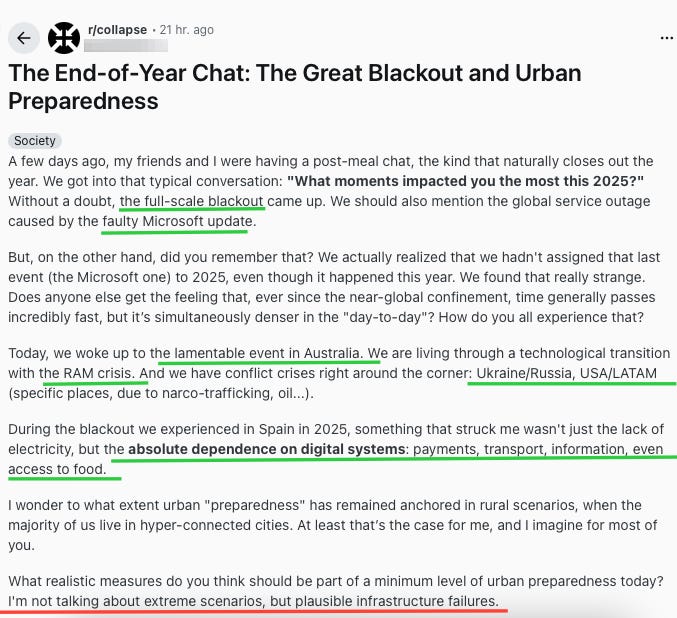
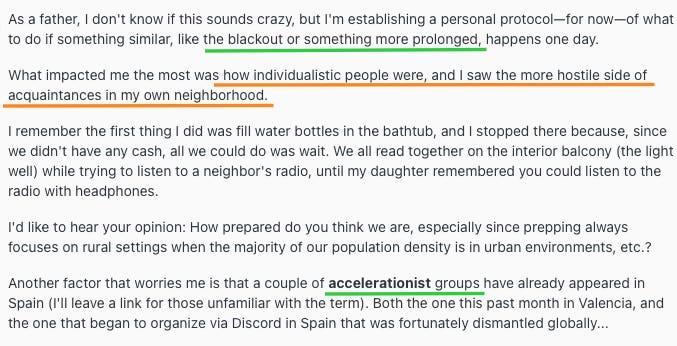
🟢 He identifies a LOT of threats!
🔴 But he lacks the underlying framework (available through my core 18 essays) for understanding that we aren’t just in a fragile situation where things could get worse; we’re in a temporary situation that is bound to unravel. Hence his distinction between “plausible infrastructure failures” and “extreme scenarios”. The rest of this century is going to be one big extreme scenario.
🟠 Interesting observations about behavior. In my Post #3.3 I write about how stressors can cause both cooperation and conflict. I’d seen accounts of how nice it was to be forced to unplug. The other side of the story is the emergencies described at the Wikipedia and BBC links above, at this redditor’s take.
Similarly, check out this post and the different assessments in the comments:
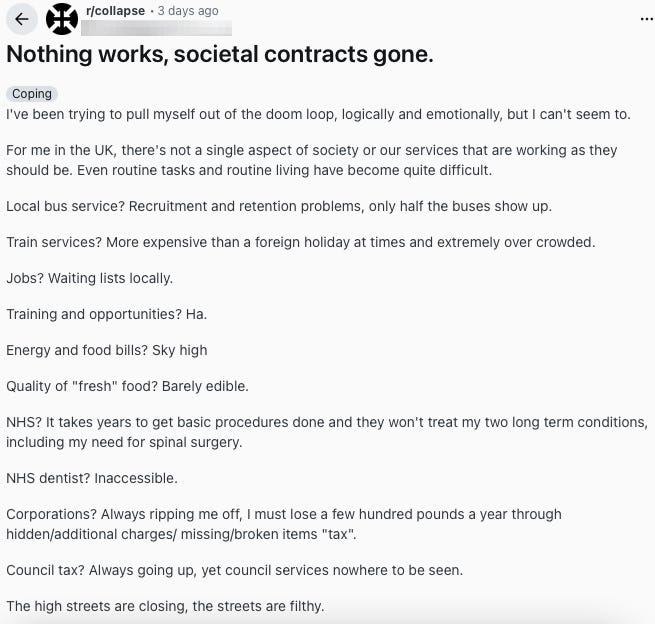
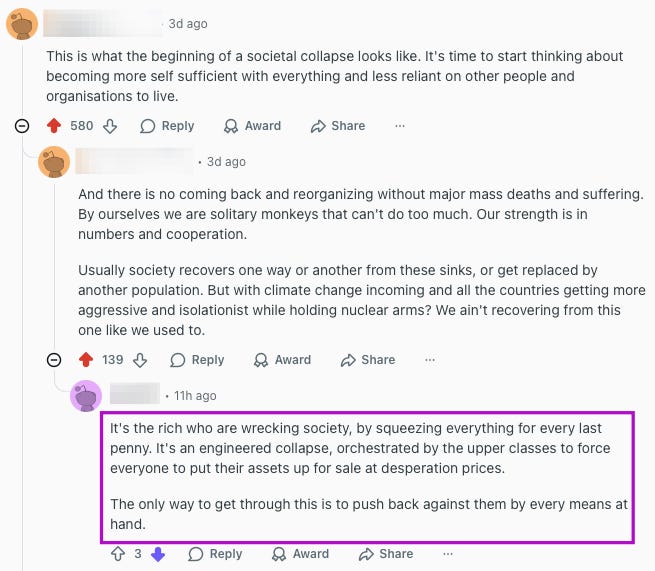
From my perspective, the assessment in purple, despite its passion, comes up short. By their assessment, The Rich engineer/orchestrate collapse, so if we (we who?) “push back against them [The Rich] by every means at hand” (what does this mean exactly?) then most of what OP mentions will resolve itself and we can go back to being pampered by the industrial-digital system. Not so. Sure, our society could be more egalitarian. But big-picture comprehension of collapse means appreciating that the industrial-digital system will be fading. Eliminating capitalism and the wealth gap won’t preserve it because nothing can.
One more example.
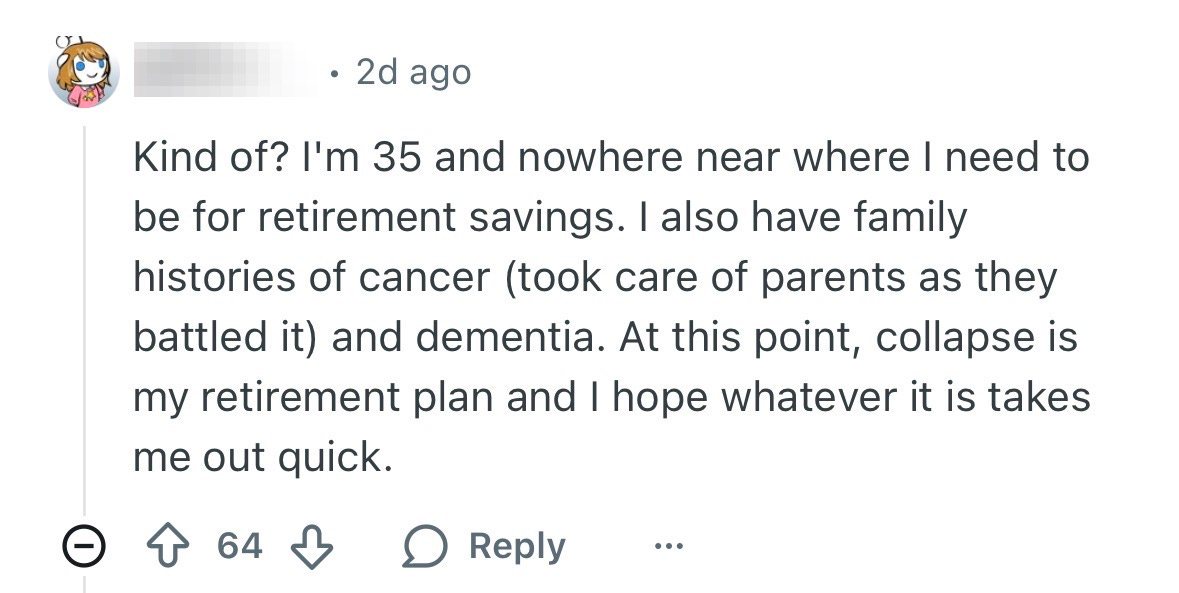
“Whatever it is” probably won’t take out this person quickly. Look at the experiences that I describe in Post #2.3. Conditions can get really miserable without actually killing you.
+ Additional Insights
Vanessa Machado de Oliveira writes that those who don’t realize that modernity (civilization) never could’ve kept the promises that it made will continue to demonstrate flawed thought patterns and reproduce destructive behaviors.
A platform like Ground News, despite priding itself on being balanced, features mostly (exclusively?) stories from a “Low Effort” perspective - because most civilization members are usually entirely oblivious to, or else unjustifiably dismissive of, the ideas that I present here.
There’s a strong inclination toward Stockholm Syndrome with all this. It’s a mindf*ck to break free and realize how much this phenomenon that we’ve been raised to identify-with and cheer-for is screwing us and the entire planet over. It takes determination -courage and discipline- to engage in Diligent Evaluation.
My Posts #5.1, #5.2 and #5.3 explain why most civilization inhabitants aren’t aware that the Diligent Evaluation exists and, if they encounter it, struggle to process it. Why are there some exceptions? Tom Murphy has analyzed how certain Myers-Briggs Types tend to be more interested in his work. (I tested as an ESTJ in 2012 and an ENFJ in 2023, and don’t find this angle too compelling.) The best write-up I’ve seen is one from r/collapse. Many of the characteristics align with personal details that I’ve shared in my About section and that probably come through in my writing - namely the “low denial tolerance.” 😅
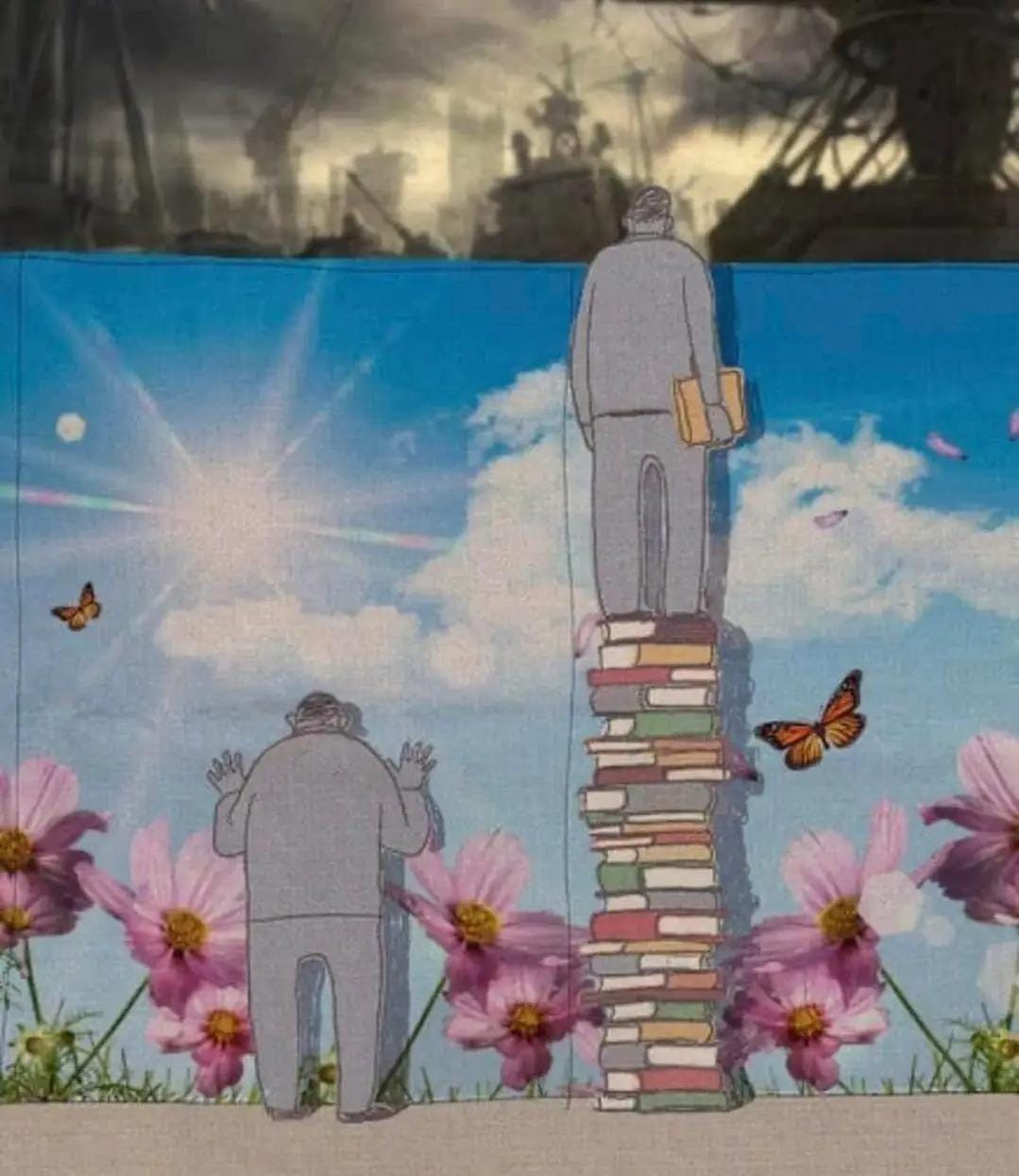
I think that my peers (Millennials) in my upstate NY town might experience collapse as follows: Rising industrial energy is what brought most non-agriculture jobs into existence, so as net energy declines, more and more jobs and entire companies cease to exist. More and more of us will lose our jobs and be unable to find new ones. Like a game of Musical Chairs, with the chairs being removed but the number of players remaining the same. Meanwhile, food in the grocery store and at the farmers’ market will get scarcer and costlier, so even those who still earn income won’t be get much for their salary. It’ll start feeling more sensible to reduce the hours that you spend earning money, so that you can instead spend more time gardening, and to spend less of your wages on groceries and more on seeds (insofar as the formal seed market supply keeps up with demand).
Thanks Andrea, I always feel wiser after reading your newsletters.
Something to think about in comparing these two lines:
1. "It’s unlikely that all those endings will be synchronized and coincide in a single, clearly identifiable year!"
2. "The rest of this century is going to be one big extreme scenario."
I sort of agree with both of these observations, but there's a tension there and I think it may be a place where some people get lost: "Well which one is it!" (binary-thinking). It may be important to tease out when someone is leaning toward one side or the other of this: "collapse is going to be slow and unpredictable" versus "collapse will be an extreme event" and show them how onset, speed, and depth are all separate variables.