

comments & questions for a memetics nerd
One of my friends thinks a lot about cultural shifts. He was generous to take set aside some time to chat (I don’t know that he expected it would go two hours…) and the following is what occurred to me afterwards.
I’m recording these comments and questions here (a) so that y’all can be clued into my ongoing thought process and (b) because I think all this content I’m about to dump works better in Substack than in an email. He can reply through whatever medium he prefers (or not at all!) i.e. y’all might not necessarily see. Deal with it.
I refer to “Titanic” scenarios that appear in a post that I’ve scheduled for March. Deal with it.

Quick(?) questions
You mentioned (I believe) that people are more likely to embrace a message if you give them purpose. Prof. Jiang (e.g. in this clip) seems to deliver a fairly grim message to his young students. What dynamic is at play in his classroom❓ Does he, at some point, provide advice/purpose❓
The host of Breaking Down: Collapse (the podcast that made everything click for me in 2022) recently posted this reflection on his first-ever episode, aired in October 2020. From an epistemological angle, what do you make of the strengths and weaknesses that he identifies in his communication strategy❓ Do you have terms/concepts for them❓
Edit: Better question - What do you think of how this episode of Human Nature Odyssey tries to communicate a vision of the future that balances realism and a best case scenario❓
You’ve written about how Hank Green is good at epistemological humility. “If” (when) we find ourselves in a Titanic-B/C/D scenario, do you think that Hank will be able to pivot❓(Is this even a useful question❓) It would mean acknowledging, e.g., that his Foundation to Decrease World Suck-funded projects (which depend largely on a functional industrial-digital order) will fizzle out.
Quick(?) comments
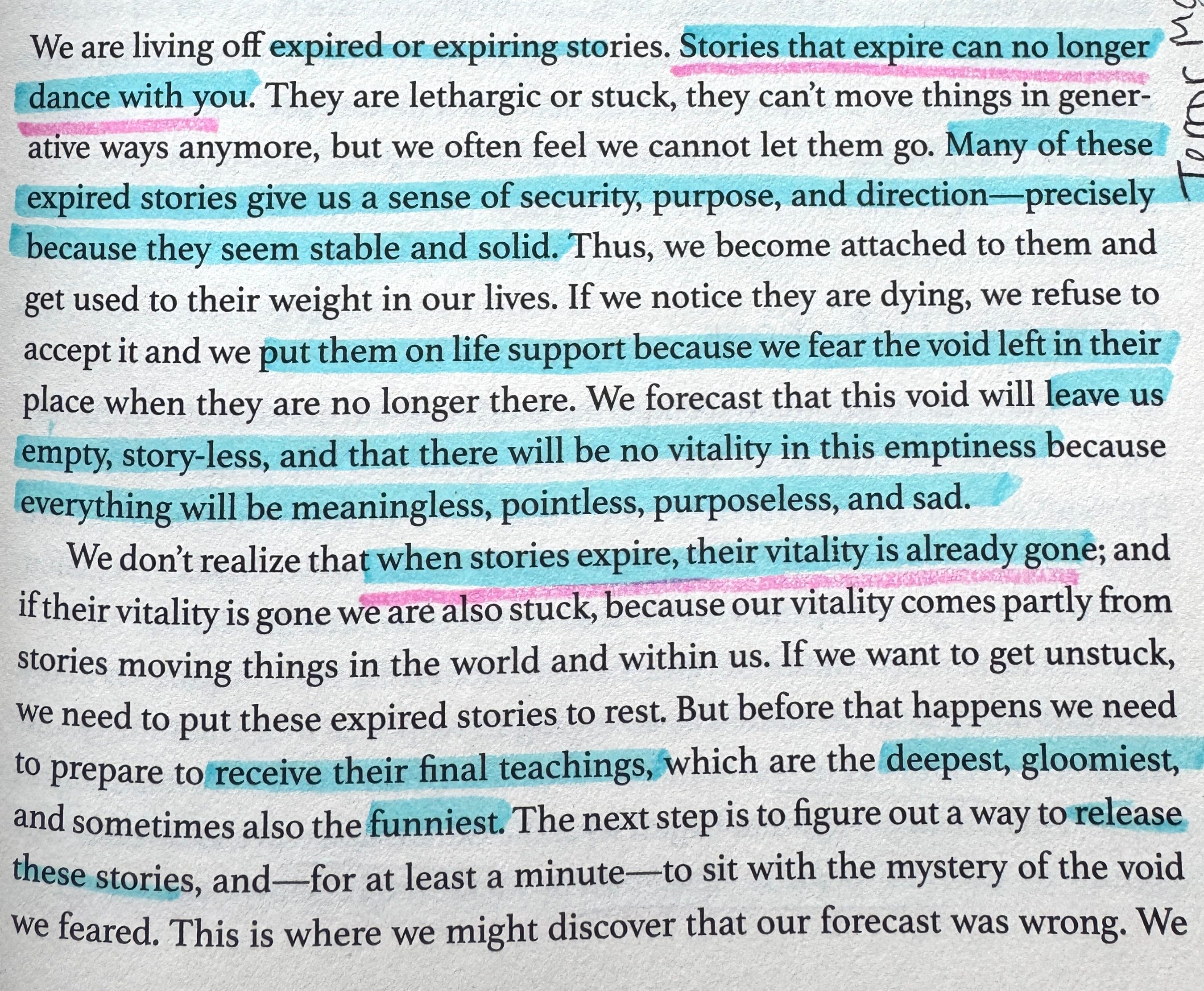
You mentioned that our peers seem down-in-the-dumps. I wonder if you’ll find this quote from Hospicing Modernity1 about expiring stories to be apt:
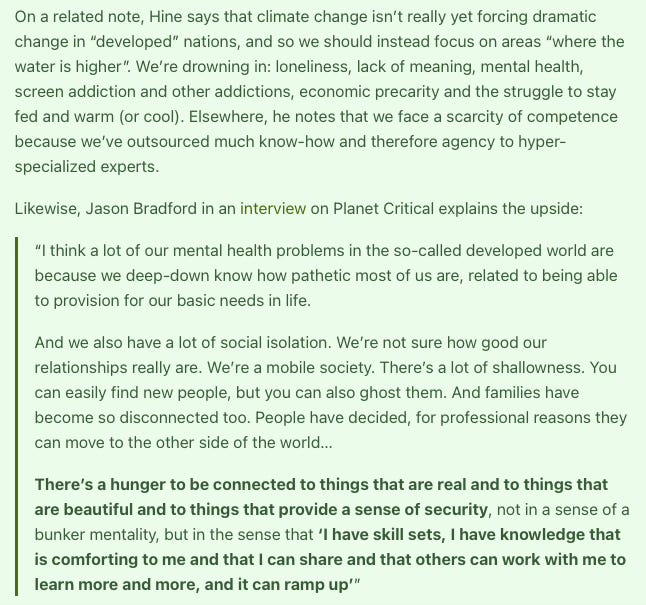
You might find this piece interesting, by Jem Bendell for the UN’s official magazine: “A New Role For The UN In An Age Of Collapse.”
I mentioned The Light Pirate as a story of deterioration that boosts morale as much as possible without being unrealistic. Here’s a redditor’s summary.
I’m wondering if you’re familiar with Douglas Rushkoff and his Guardian piece (and book) about billionaires’ bunkers. You asked what investors could do with their wealth that would also benefit “my cause”. The article mentions a JC Cole who runs American Heritage Farms. His idea is that people who feel inclined to buy a bunker could also fund the establishment of relatively supply-chain-independent farms in their area, to keep local residents fed and preempt the need for a bunker.
Sprint and/or Marathon?
You noted that we have distinct views of the timeline and asked if my cluster has a term for the transition period between now and some end state. I’m realizing now that we refer to a “Long Emergency” (taken from John Michael Greer’s book), but it lasts the whole century.
You and I both anticipate a near-term sudden shift. However, Rationalists’ “supernova” sounds like bedlam2 whereas our “Bend-Not-Break” refers to top-down decisions from those who hold the power to enforce new policies and programs. Nate Hagens discusses it in this talk at 28:10 (or go back to 20:55 for more context).
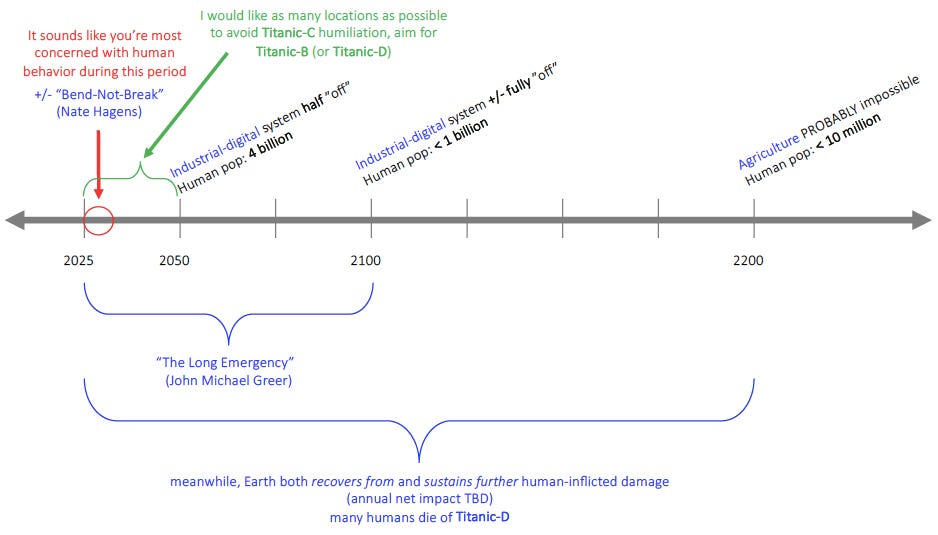
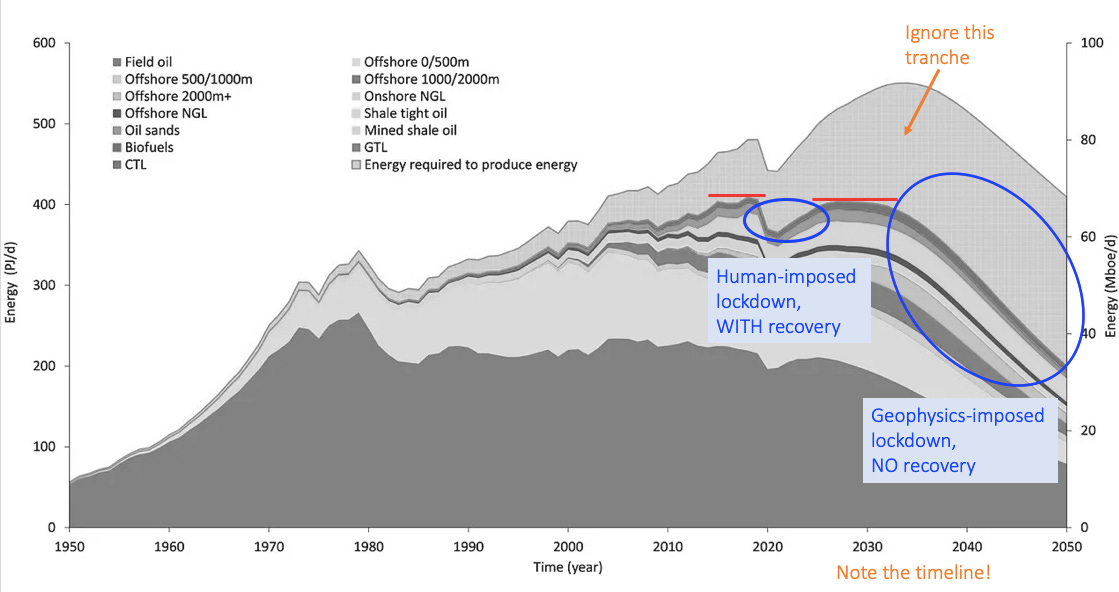
So maybe the bet that I mentioned shouldn’t be on whether, between now and 2040, the Titanic sinks further or bobs up.
Instead, the bet might be about whether the major disastrous thing that Rationalists fear will occur by 2030 comes to pass. If it doesn’t, they might want to brace for a more extended decline. Adrenaline can only power you for so long.
And I wonder whether our peers who already feel dead inside can just remain in that state for years or whether, as circumstances continue to get nastier but nothing actually kills them immediately, they’ll start seeking to replace it.
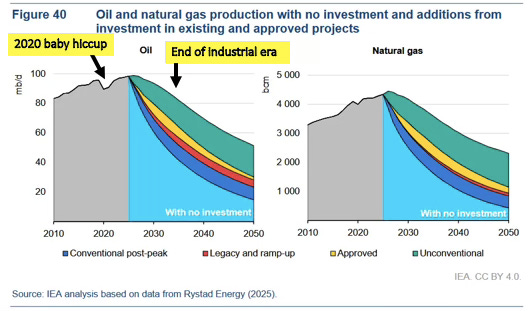
Behavioral Burst
Could you explain the concept of a supernova a bit more❓Who would the participants be❓
I keep an eye on unrest around the globe. There’s definitely crime, conflict and suffering. But I don’t see anything really blowing up and leaving a vacuum.
For example:
Take these photos and statements from the Philippines. I think that, even though they express hope that conditions improve, they understand that they won’t. It’s just that they can’t say in an interview, “It’s all downhill from here.”
Take the Gen Z rebellion in Nepal. People always organize to restore some order after the chaos, I think.
Take this description of life in Afghanistan:
In Kabul, Afghanistan, “some households spend up to 30% of their income on water, with over two-thirds incurring water-related debt.” … Kabul might become the first capital city in modern history to run dry. “Up to 80% of Kabul’s groundwater is contaminated … a consequence of widespread pit latrine use and industrial waste pollution. 'Diarrhea and vomiting are ‘problems people experience all the time in the city’”

I do worry about humans “going supernova” against Earth3.
The following examples are drawn from my post Rx #1: Inner Work for Your Apocalypse. There, I also include arguments for why humans in some regions might lack the perfect storm of incentive, opportunity and skill to decimate their surroundings.
Hungry humans hunting wildlife to extinction
In 2024, in response to drought and food insecurity, Namibia culled 700 wild animals for meat, including elephants, hippos, buffalo, impala, blue wildebeest and zebras. Granted, 700 isn’t actually that many, but given how dramatically human mammals collectively outweigh wild mammals (see the bottommost bar’s blue and teal segments in the chart below - and presumably we’d have already exhausted the livestock option), one might imagine that humans would eliminate the small remaining population of land mammals, plus many birds.
Desperate humans chopping down all the trees as fuel
In 2024, in Mali, people desperate for firewood chopped down trees that activists has planted. During war-induced fuel shortages in Syria, residents removed 20% of its forests in 10 years.
Desperate humans burning (toxic) synthetic material as fuel
As of 2025, it’s becoming common to burn plastic as a fuel for cooking and heating homes (e.g. 13% of Nigerian households). In Indonesia, tofu companies use plastic as fuel because fossil fuels and wood are more expensive. The fumes cause lung disease, cancer, and reproductive and developmental problems.
Sub-Topic: “Do You Want People to Know?”
Maybe we should be asking: Know what? I think that the two extremes of paralyzing depression (which you’re observing) or panic (which you’re imagining in the next few years) are what you get when you leave people to their own imaginations, which are “trained on” Hollywood and video game content. The “marathon, not a sprint” framing (/reality) might not produce the same results. I feel depressed and panicked, too, but maybe just not as debilitatingly.
If in 2020, people had a preexisting model from a trusted figure, saying that “Lockdown is actually going to be pretty boring. You’ll be wishing for an excuse to step outside your house” (+ they now have that model through their own experience), they could’ve either skipped the panic shopping or stocked up in advance, calmly and gradually. I think the reason they didn’t stay calm is because horror/action movies were their main basis for setting expectations, and so you get the toilet paper rush.
Some other reasons that I’m not too worried about helping people become more informed:
By making information (about the industrial-digital era’s expiration over the next few decades) available to the wider public and trusting them to engage with it when they’re ready, you empower would-be wise actors to make informed choices. It’s common (and granted these people are self-selected) to see people on collapse-related platforms say that they’re glad to be aware. … It seems silly/wrong to keep those people -ones who would act more wisely if they knew- in the dark.
In the short term, we might see demand exceed supply for certain items that will soften the transition to post-industrial living. But industries could, in time, redirect productive capacity.
And “leaders” (governments? corporations?) would be positioned to discuss critical issues like spent nuclear fuel in a way that we can’t while pretending that industrialism will continue. Max Wilbert has a good summary of this issue.
It feels a bit icky and mansplain-y, like “People couldn’t possibly handle what I know.” My cluster is guilty of this.4
Amp Them Up Before You Bum Them Out
That’s my twist on your insight: People have to want to live before they care about dying.
I think that when it comes to boosting morale…
Offering “hope”: If you gloss over the coming ugliness5, and people don’t experience the future that you promised, you lose their trust. Within/adjacent to my cluster, I sense this about Rob Hopkins’ How to Fall in Love with the Future and Jeremy Lent’s concept of an eco-civilization. I’ve been calling this pleasant-washing.
Seeking “hope”: If you pick a morale source that doesn’t accommodate all the coming ugliness, and reality doesn’t match what you’ve been envisioning, you’ll face disappointment and discouragement.
Reality isn’t going to conform to your “existential comfort requirements” but you can adapt your comfort strategy to what reality can offer. I think that’s a fair version of “hope”.
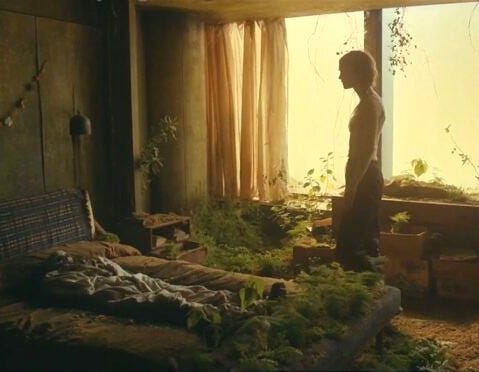
When I asked r/collapse for book recommendations, they described Hospicing Modernity as “heavy”, “brutal” and “made me feel nauseous at times” - whereas I was already in such a dark headspace that I got through the whole thing unfazed.
As if we haven’t already - I’m sure you’ve heard of the Great Acceleration.
My own cluster perpetuates the idea that “if people really got it, there’d be chaos!”
Nate Hagens in his 2025 reflection: “I don’t want to scale this to millions of people. Of course, I want to grow the podcast. And by the way, if everyone in the world knew this story the way that I’m telling it, that would become a self-fulfilling prophecy and people would start hoarding, and a fear-based response would likely happen, and I don’t want that. I also don’t want zero people to know about this. So there’s some point in the middle where some sort of a prosocial Scout team prepares both physical things, but also educational things, and starts pilots”
Adan Noone has a post, too, “The Bell Ringer’s Dilemma”
Ugliness isn’t new. Human’s campaign of planetary domination (“civilization”) has always entailed atrocities (doom) for all other species and for less “ambitious” (read: belligerent) human societies. It’s just that the ugliness/doom is now coming around to bite us, the most pampered tiers of domesticated humans.
appreciated the UN piece by Bendell. Also a shoutout regarding ‘certainty’ and it’s possible/likely wrongness - I think of old oil drum heads disillusioned and suffering a long letdown about things peaking. Maintaining momentum and purpose in the face of unknowing isn’t easy at all.
Why does prof. Jiang write and speak in English if he's teaching in Beijing?
Mary Midgley's book on the myths we live by has a good takedown of Dawkins and his memetics. TLDR: it's bollocks.
To hell with the Great Theories, the Graphs. Just enjoy each day. It's all you have.