

Earth and its Werld
I just learned what “world” means.
I was going to start this post by complaining that others are misusing the word “world”, but it turns out I was. Its roots in Old English are “wer” (man) and “eald” (age). So when the Post Carbon Institute’s website says that they’re “leading the transition to a more resilient, equitable, and sustainable world”, they’re at least justified in identifying the wer-eald as the thing that’s facing sustainability issues. And Vaclav Smil’s book, Feeding the World, is indeed concerned only with feeding domesticated, agriculture-reliant humans.
Where we go awry, however, is in using this term interchangeably with “all that is”. There’s much more beyond mankind and man-space.
Eileen Crist says the same of the term “oecumene”, calling its emergence “a significant sign of the lodging of anthropocentrism into language and thereby into broadly shared patterns of thought.” Oecumene means “the inhabited world”, as if spaces devoid of humans (particular kinds of humans) are uninhabited. She points out that by ignoring what civilizations erase as they spread and highlighting what moves in to occupy, it functions as an imperialist euphemism.
If we consider that there’s something beyond our Werld (I’m inventing this term because it’s going to come in handy…), we’ll be in a much better position to understand what’s happening to us and what will (or could) (and couldn’t/won’t) happen to us.
Behold, the WORLD! Like, ALL of it!
The following are some terms that I’ll use in my next post, which will seek to answer “Why is the world in crisis?” with some statements that someone who is not entirely sold on the inevitability of the Werld’s impermanence can test.
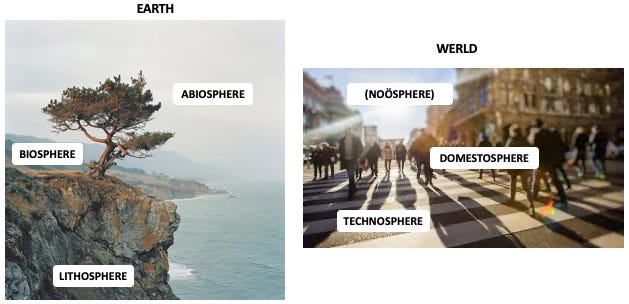
Lithosphere - Earth’s crust. Minerals, metals, and coal/oil/methane. These last ones formed about 300 million years ago, over millions of years, from decomposing vegetation.
Abiosphere (I made this up. Formally, it’s the atmosphere + hydrosphere.) - Abiotic factors. The parts of “nature” that “aren’t alive”. Sunshine, clouds, temperature, wind, precipitation and bodies of water, fire. This site lets you explore how it has changed over time!
Biosphere - The parts of “nature” that “are alive”. For the sake of my categories, this includes only “wild” species of plants, fungi, animals and other kingdoms - those who know how to meet their essential survival needs in the absence of agriculture and the Technosphere.
I’m going to refer to these three realms as Earth.
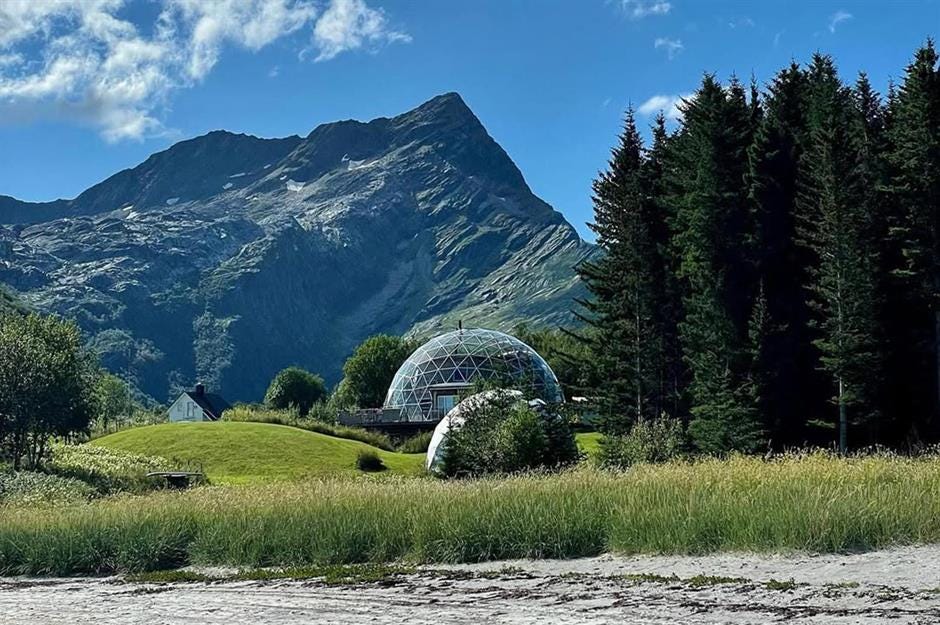
The remaining realms belong to the Werld.
Technosphere - The infrastructure that Werld-humans create to facilitate the production and exchange of “goods and services”. (Earth’s organisms also trade molecules and provide each other with support, but it doesn’t look quite like The Economy.) Some parts are made of biomass (i.e. wood) but much of it comes from the Lithosphere.
Infrastructure includes: roads, bridges, tunnels, aqueducts, pipes, dams, solar panels, wind turbines, data centers, cables and wires, trains, planes, all wheeled vehicles, excavators and other heavy machinery, buildings
Goods that, through the Technosphere, come into existence and are transported: books, personal protective equipment, chemotherapy drugs, insulin, vaccines, condoms, surgical tools, hip/knee replacements, bicycles, orchestra and band instruments, eyeglasses and contact lenses, toothpaste, sunscreen, appliances, devices
Domestosphere (I made this up.) - Creatures that inhabit the Technosphere and depend on it as an intermediary for meeting their basic survival needs: thermoregulation, water, food. Their requirements are the same as the Biosphere members’, but Domestosphere beings don’t know how to meet those needs directly on Earth. These include humans (but not all of them), and species whom those humans keep as crops, livestock and pets.
Noösphere - The “official” definition of the Noösphere, according to my Google search, is “the ‘sphere of human thought’ … [a] layer of consciousness, intellect, and technology, where human minds and their creations (like the internet, art, science) profoundly influence the planet, making humanity a geological force. Developed by Yernadsky, de Chardin, and Le. Roy…” … I’d like to make some tweaks to the official definition - NoösphereAP?
NoösphereAP isn’t necessarily global. It also existed in 10,000 BC on a small scale. Maybe that’s a proto-Noösphere. I’m more concerned about material reality in this substack anyway so not worth fussing over.
NoösphereAP isn’t human-exceptionalist or teleological. I get a liiiiiittle bit of a sense that the term’s originators think humans are the only species who think and that Werld-humans have some special status/destiny, as if we’re Earth’s favorites. I’m not promoting any of this “thought integrates with nature, evolving into a new state of global functioning” stuff.
NoösphereAP is heavily influenced by the anthropological theory of cultural materialism which says that in the pyramid below, the influence is primarily bottom-up. I reference it in Post #5.1. The Noösphere that I’m writing about encompasses the Superstructure and Structure tiers.
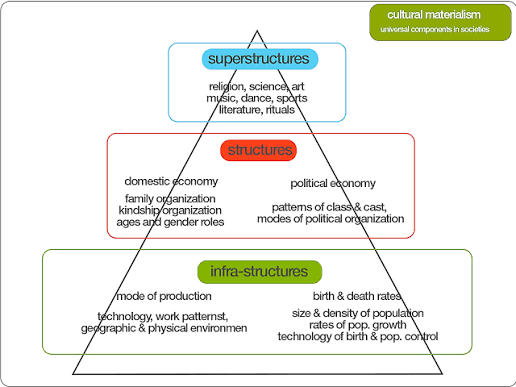
This realm isn’t material in the way the others are. These are really descriptions of patterns and modes in which the Technosphere and Domestosphere can function. Biosphere creatures can approximate them, but these look very different without the Technosphere and without the way that Werld-membership conditions Domestosphere creatures to design them.
Examples: weekends, grocery trips, Rights and Freedoms, Mergers and Acquisitions, Progress, Democracy, Healthcare, Education, Journalism, Data Analysis, Money / Banking / Investments, the Cloud, Status, Cuisine, Entertainment, TikTok trends
Disclaimers
Yeah yeah, separability is an illusion and everything is alive. For my intents and purposes in this post and the next, my categories are useful/relevant.
It’s possible that an organism is capable of meeting some of its survival needs without the Technosphere. I’d rather keep these categories as they’re defined and allow for describing that creature as having split membership.

Can a human stop playing civilization?
Defender tweeted in August 2024 (as shown in this post), “this whole civilization thing is just a game where anyone is allowed to make up new rules and you can stop playing whenever”. The post itself didn’t define civilization or playing/quitting - but the statement was enough for me to examine through the lens of these realms.
There’s definitely evidence of Domestosphere members successfully “onboarding” (to use Defender’s term) Biosphere members - in “residential schools” that sought to “Kill The Indian, Save The Man”. Later, industries emerged and forced humans who were already members of the Domestosphere to adopt ever-more-advanced technology, such that they abandoned the teaching/learning of lower-tech methods of meeting survival needs and became even more reliant on infrastructure.


photo source & source
Has it ever worked in reverse? Granted, when Europeans arrived in “America”, it was common for Werld-humans to defect, join Earth-humans and resist “rescue” attempts. But what about without the Werld-human being able to join an experienced tribe of Earth-humans? I foresee some barriers:
If you’re born and raised in the Domestophere, your community would not have immersed you in those daily survival routines since birth, as is the case for Earth’s humans. You would first have to reach an age where you’re capable of realizing that it would be wise or at least desirable to know how to meet your survival needs continuously out on Earth. You would have to invest a lot of time to develop the knowledge and skills.
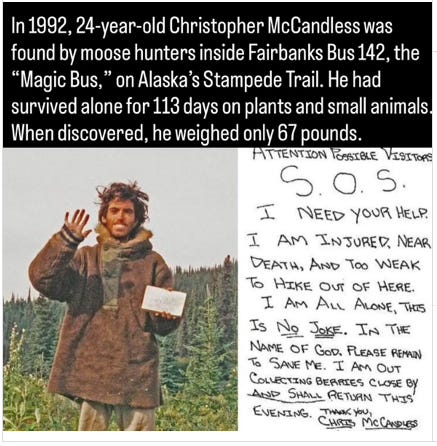
You’d be foraging and hunting, which means you need access several acres where wild plants, fungi and animals live. Unfortunately, the Werld made up a rule where you have to provide goods and services in the name of the Werld, to earn tokens, which you can eventually exchange for the permission to consider a parcel of land “yours”. If you seek calories there without dibs, Enforcers of the fake rules will force you to pay tokens or else go to prison.
Even if you get the land, you still need to adhere to another of Werld’s made-up rules and pay tokens annually for the Technosphere and Noösphere that you’re trying to escape. To earn those tokens, you need a “job”, which tends to require adherence to certain standards about your appearance, so you’ll find yourself engaging with the Technosphere again.
Final twist!: Even if you did successfully cut ties with the Werld, it tends to eliminate Biosphere members, whether by slaughtering them, starving them or absorbing them (as is the case with “successful” attempts to “civilize” and “domesticate”). Tom Murphy explains in “The Ride of Our Lives” that societies didn’t really have a choice to not join the self-destruction.
Suffice to say, it’s definitely not easy to quit.

At the Werld’s Mercy
If the only way you know how to pursue thermoregulation, water and food is through the phenomena that Werld happens to offer, their you’re stuck accepting whatever deal Werld extends in exchange for keeping you alive.
For some Werld-humans, that (for now) means something called “employment”, which is rewarded with “income”, which can be traded for food at places like grocery stores and farmers’ markets, or maybe even through some kind of subscription service. Neat-o! But that’s not the case for all Werld-humans everywhere and across all time.
If (when) your particular arrangement changes, and you will have to accept it because you don’t have the skills or land to meet your survival needs in any other way. If there were (when there is) no arrangement of any kind available, you’d be relatively helpless.
The impetus for this shift doesn’t even need to come from actors within the Werld. Earth can make it so, regardless of what Werld leaders want.
I don’t have a way to wrap this up - just an invitation to share thoughts in the comments and pay attention to how people use “world” differently, and what implications it has for what they’re saying.
It's the end of the world as we know it, and I feel fine.
> Earth’s organisms also trade molecules and provide each other with support, but it doesn’t look quite like The Economy
this is an important "B" in most of the ORI network. You made a comment here about "positive sum vs negative sum economic growth" (https://open.substack.com/pub/defenderofthebasic/p/why-are-we-rewarded-for-making-things?utm_campaign=comment-list-share-cta&utm_medium=web&comments=true&commentId=177224513) and I wanted to explain exactly this - the "human economy" is one system, but the principles of trade, cooperation, and growth are more "root level" concepts.
(knowing that this is a B in a given network should help in language/translation which should help in idea/truth propagation)
> Spectrosphere
This can also be translated to "noosphere" for rationalist & rat-adjacent networks
> Has it ever worked in reverse?
one of the ideas I've been trying to propagate (not very successfully widely but for whom it resonates it does work well) is picturing civilization as an actual company that you work for (it does need to function as such. There are jobs to do, and failing to do those jobs has consequences), which I think naturally leads people to ask, "how do I quit/move to another one"
> If you the only way you know how to pursue
typo, extra "you"
> you’re stuck accepting whatever deal Werld extends in exchange for keeping you alive
this we can see in the natural world as an example of a parasitic relationship (and those are usually more fragile than symbiotic ones). An organism that drains its constituent parts will not survive long. A general principle that applies to biological organisms, or an super-organism like civilization