

Is Earth experiencing a major mass extinction?
I care to be accurate in my claims, so that I can earn and retain readers’ trust and respect. To that end, I recently sought to clear up my understanding of what constitutes an extinction event and if Earth is experiencing one. I learned and now you can learn!
I. Definitions
What is…
Extirpation❓ when a specific species (is that redundant?) is erased from some area. Humans extirpated the American bumblebee from at least eight states. However, the American honeybee still exists in some places. However, its population dropped 80% from 2001 to 2021.
Background extinction rate ❓ the steady rate at which Earth’s species tend to go extinct. It’s about 10-100 species per year.
Major mass extinction❓a period during which Earth loses >75% of species over a “geologically short time” (like, under 2.8 million years).
Minor mass extinction❓a period during which species disappear at above the background rate, but you don’t lose 75% of them.
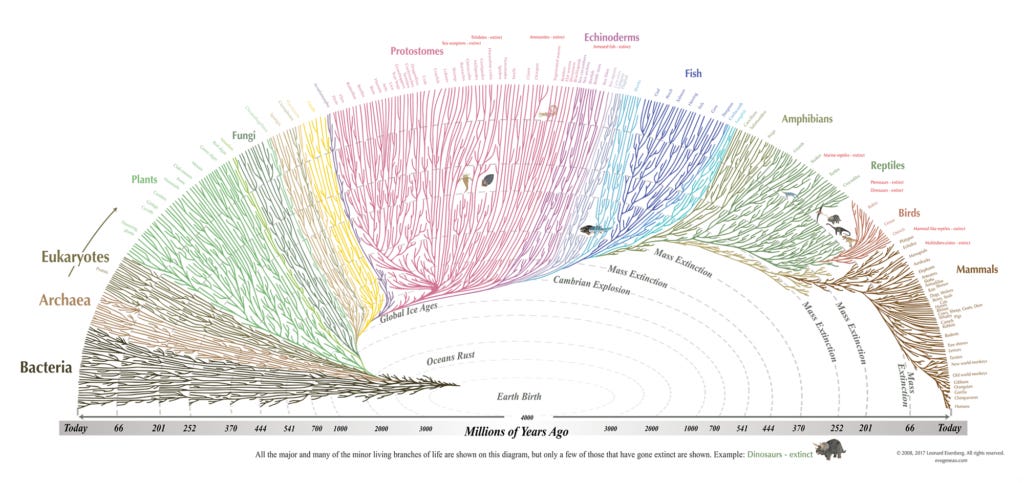
II. Deep Time Perspective
How long Earth existed❓4.5 billion years
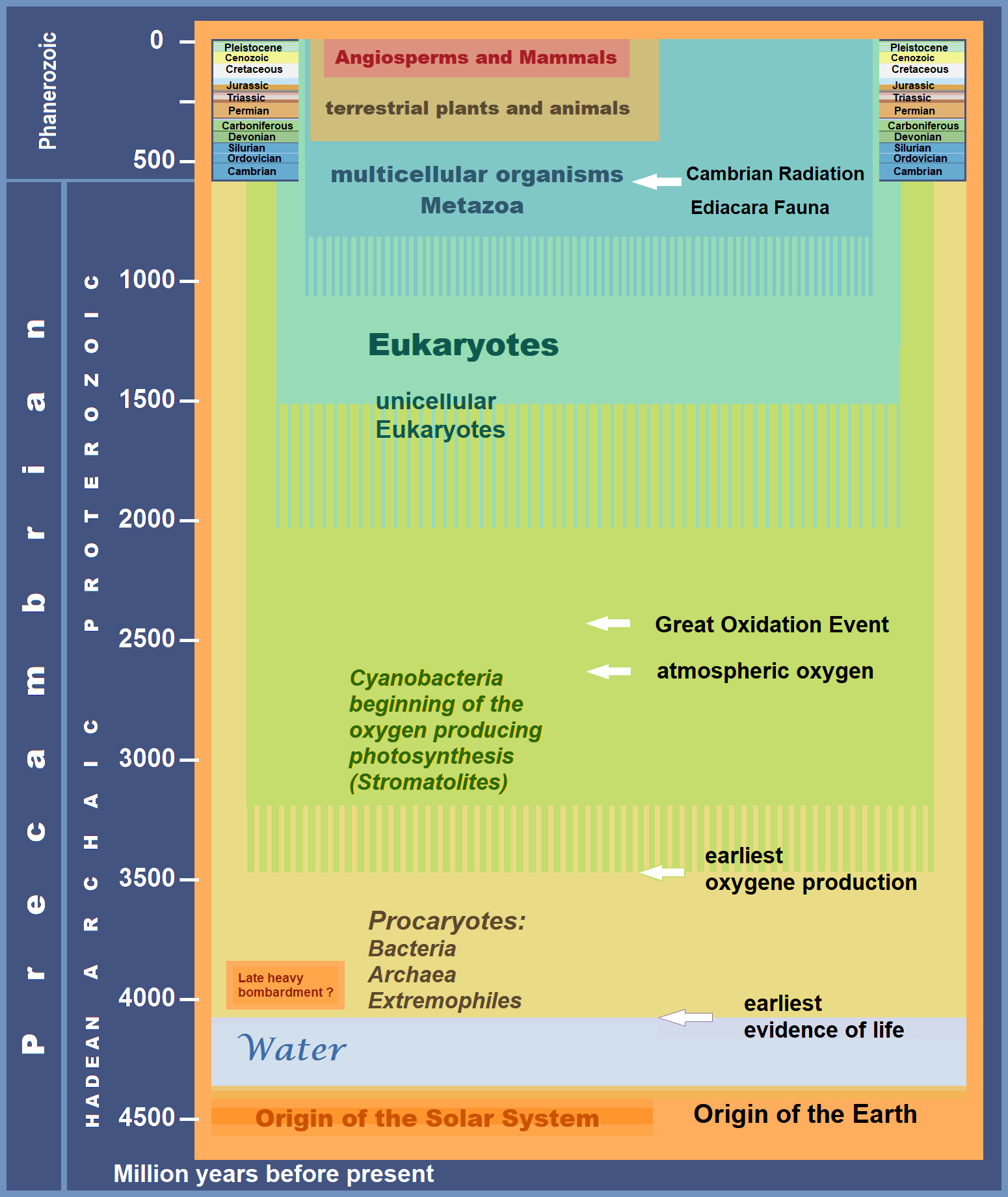
How long has Life existed on Earth❓at least 4.1 billion years
How much longer could Life exist on Earth❓maybe 1.5 billion years
How much longer could Earth exist❓+/- 6 billion years
III. Previous mass extinctions
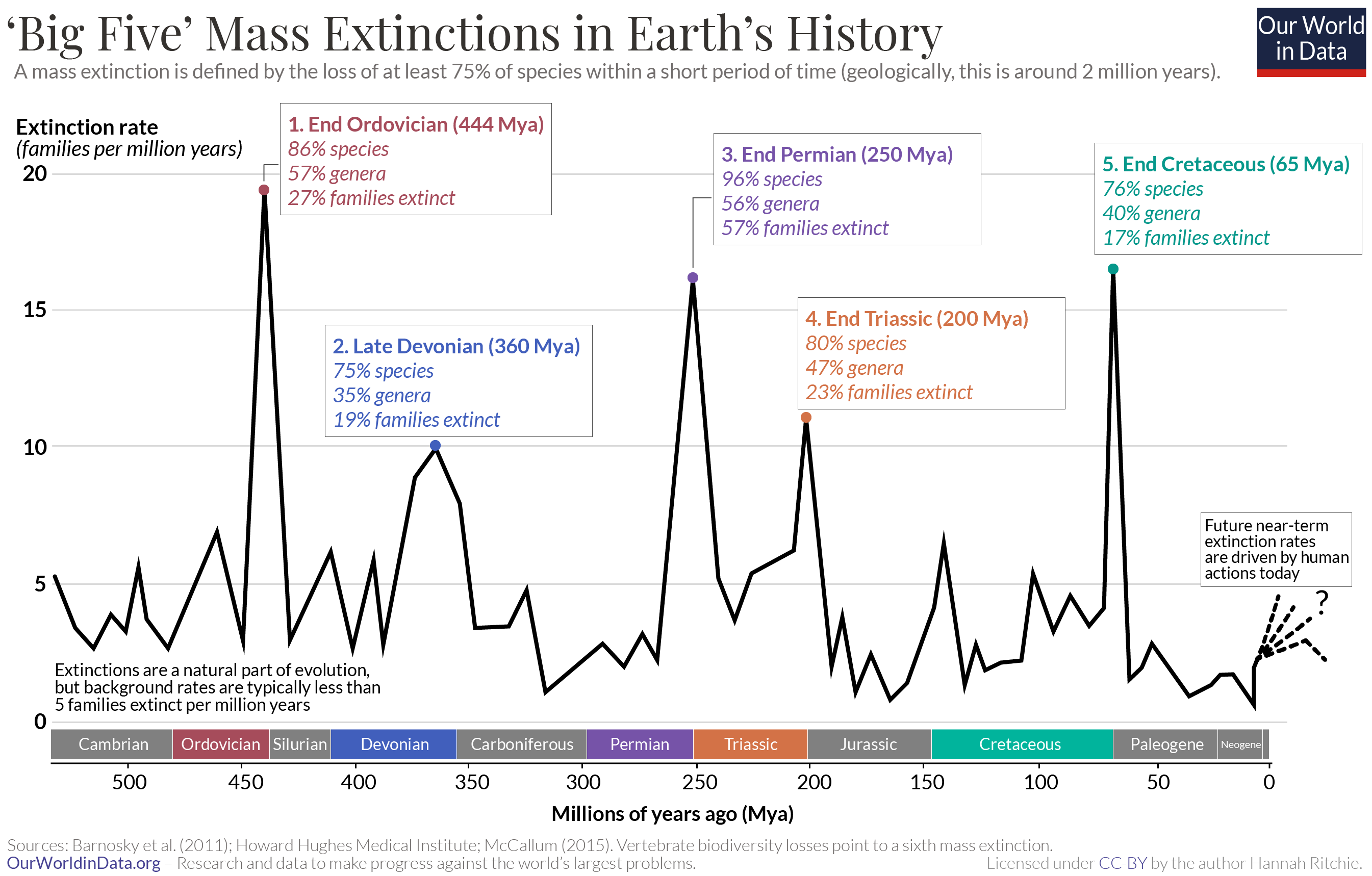
When did they occur❓Here, have some charts!
Note the Y axes. This one’s Y axis is families lost, and it’s a plain number, but you can see species-as-a-percent (the official definition of extinction) in the data labels.
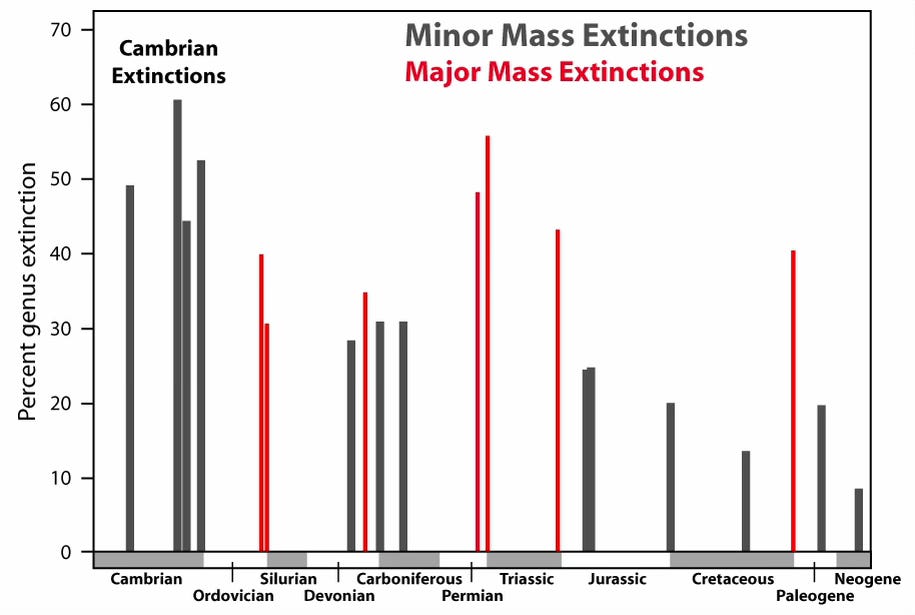
This next one is also worth noting. Its Y axis is based on genuses, and they’re taken as a percent. I like this one because the Cambrian Extinctions are apparent. Clearly, lots of creatures died. But it doesn’t show up on the first graph because Earth’s animals weren’t that diverse to begin with. If your whole planet is inhabited exclusively by giraffes and scorpions, and all the giraffes die, you’ve lost 50% of your species but “the extinction referees” don’t consider that a significant loss.
IV. The past two times Life wiped out Life
Is Homo sapiens the first creature to cause elevated extinction rates❓ Nope!
Around 2.7 billion years ago, cyanobacteria evolved. The could photosynthesize! Earth’s atmosphere back then was mostly carbon dioxide and methane, without today’s oxygen and nitrogen. So that’s what Earth’s earliest organisms developed to breathe: carbon dioxide and methane. But as cyanobacteria photosynthesized, they combined CO₂ and H₂O, producing (among other things) O₂. The cyanobacteria were very successful and generated so much O₂ that nobody could breathe. Oops! Biosphere Reset! Voila, Great Oxidation Event. All that O₂ probably also caused Earth’s first ice age and led to Ozone Layer formation.
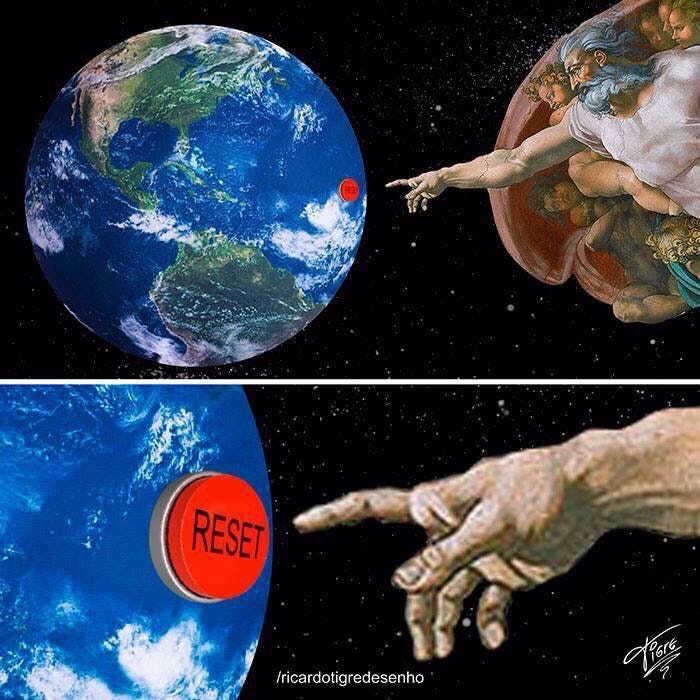
The other creature-caused reset was the Devonian mass extinction. Around 372 million years ago, photosynthesizers were at it again! Plants and fungi had made their way onto land and were zealously metabolizing minerals. Those minerals ran off into the oceans. Cue giant algae blooms, anaerobic microorganisms digesting those swathes of dead plant matter, and everybody suffocating again, this time on CO₂. (Volcanic eruptions also played a role.)
In a way, these would have been a more appropriate metaphor to serve as the premise of Don’t Look Up, rather than a comet hitting Earth. Pixar movie?
V. Life bounces back
How long does life typically take to re-diversify after a major mass extinction❓ maybe 10 million years
I recommend reading this Guardian article about “a climate of unparalleled malevolence” at the end of the Permian Era. Terrestrial Life has been through some sh*t.
And yet, today Earth has a new full cast of characters! Including juicy fruit! (That came after a later extinction.)
VI. Current situation
Is the current extinction rate above the baseline❓Yep, elevated and rising. (Remember, the “normal” Y value here would be 10-100.)
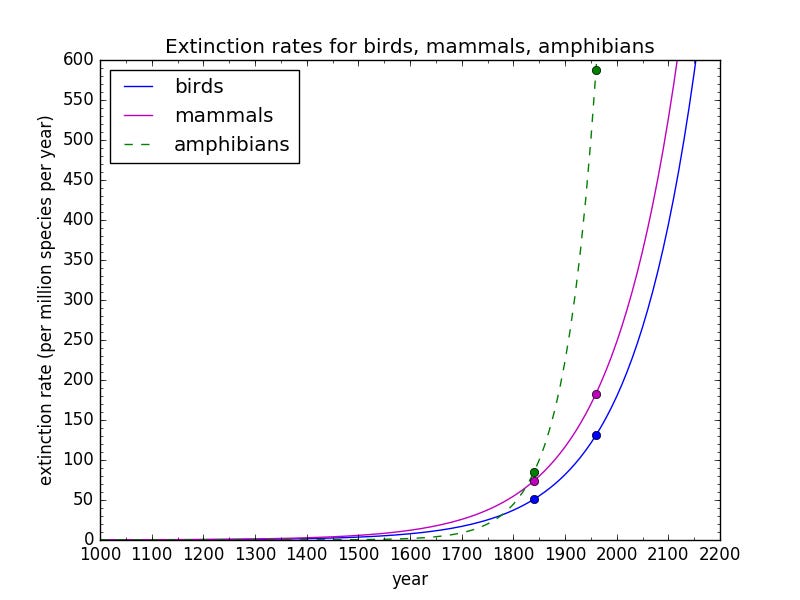
🆘 Tom Murphy’s data above show an increase between 1840 and 1960 (in the “Ecological Impacts” section here, he mentions getting them from Our World In Data). Meanwhile, this meta study found that diversity loss isn’t as intense now as it was in the late 1800s and early 1900s. Does that mean his curve be more parabolic than exponential?
So far, this has all be about diversity. Diversity is important to a functional ecosystem, but it isn’t the only thing to be watching.
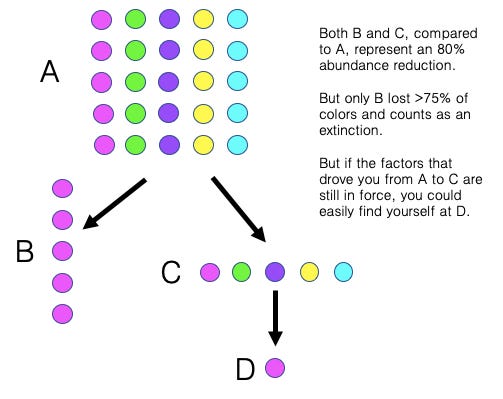
So, what about abundance❓Yeah, about that…
From 1970 to 2020, overall wildlife abundance dropped to 69% (measured by headcount)
From pre-industrial times to today, large predatory fish abundance dropped by 90% (measured by mass)
From +/- 1990 to 2020, insects saw their average total abundance (headcount) drop by 58.4% (see Table 2) … The ones we tend not to like (crop pests, mosquitos, ticks) are increasing in number, but on net there’s a decline … Also, DRAMA:
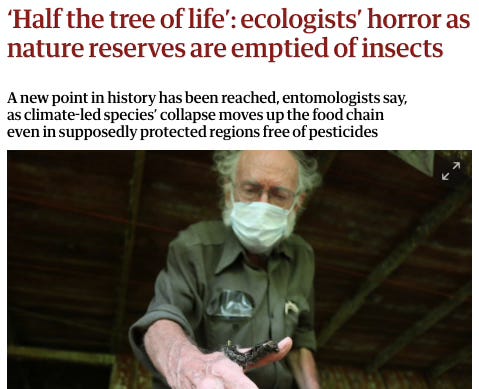
In 2019, Sánchez-Bayo and Wyckhuys published “Worldwide Decline of the Entomofauna: A Review of Its Drivers.” Here’s the Guardian story in normal-people language.
Then, Saunders et al. came out with “Moving On from the Insect Apocalypse Narrative: Engaging with Evidence-Based Insect Conservation.” They called the global media coverage of the original study “exaggerated” and “confusing and inaccurate science communication”, and insisted that “a limited number of studies that are restricted geographically … and taxonomically” and “biases in sampling and analytical methods” rendered Sánchez-Bayo and Wyckhuys’ findings invalid.
So Sánchez-Bayo and Wyckhuys were like “f*ck you guys” and came out with “Further evidence for a global decline of the entomofauna.”
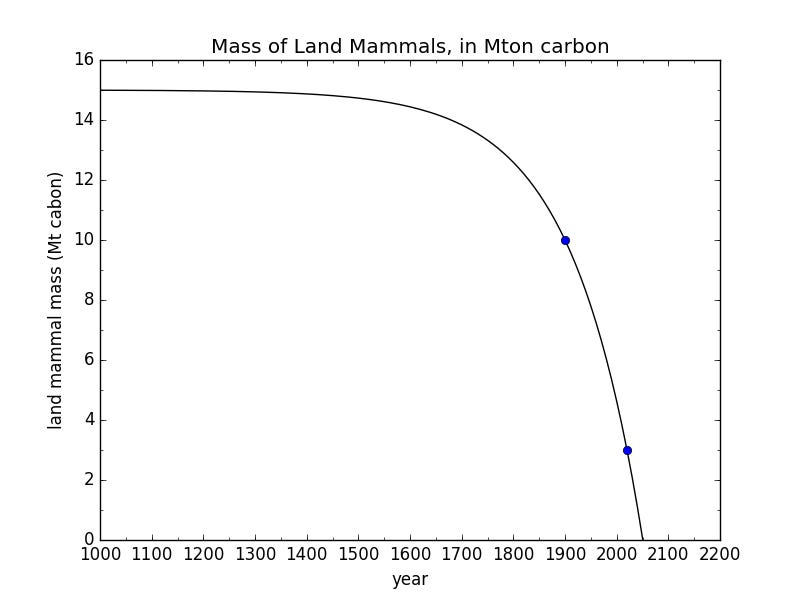
At the current rate that the Werld is exterminating wild land mammals, there will be NONE by 2050 (which isn’t to say that the Werld will fully succeed). See curve below.
Over half of Earth’s species belong to phylum Arthropoda! 🕷️🦀🦂 A subset of it, class Insecta, has the most members of any class. 🪲🐞🦋🐜🪰🐝
VII. Main causes
What’s causing this, primarily❓
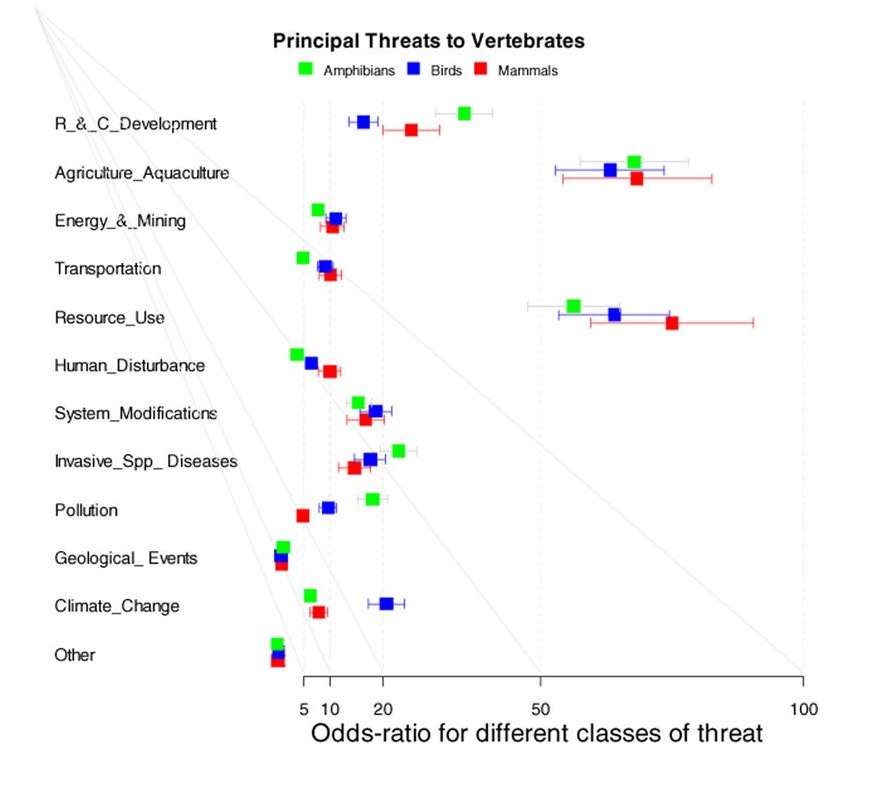
When is comes to amphibians, birds and mammals, agriculture is tied for first with “resource use”. (If someone wants to look into what “resource use” means, be my guest.)
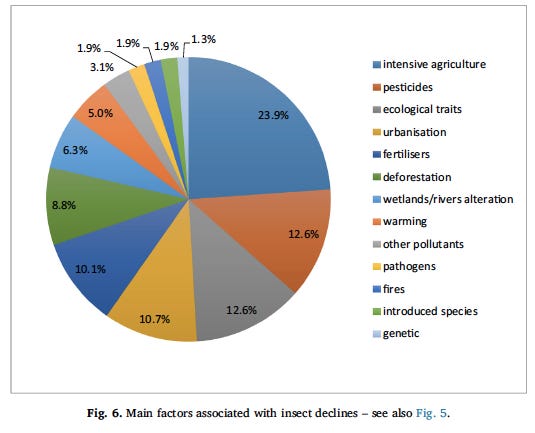
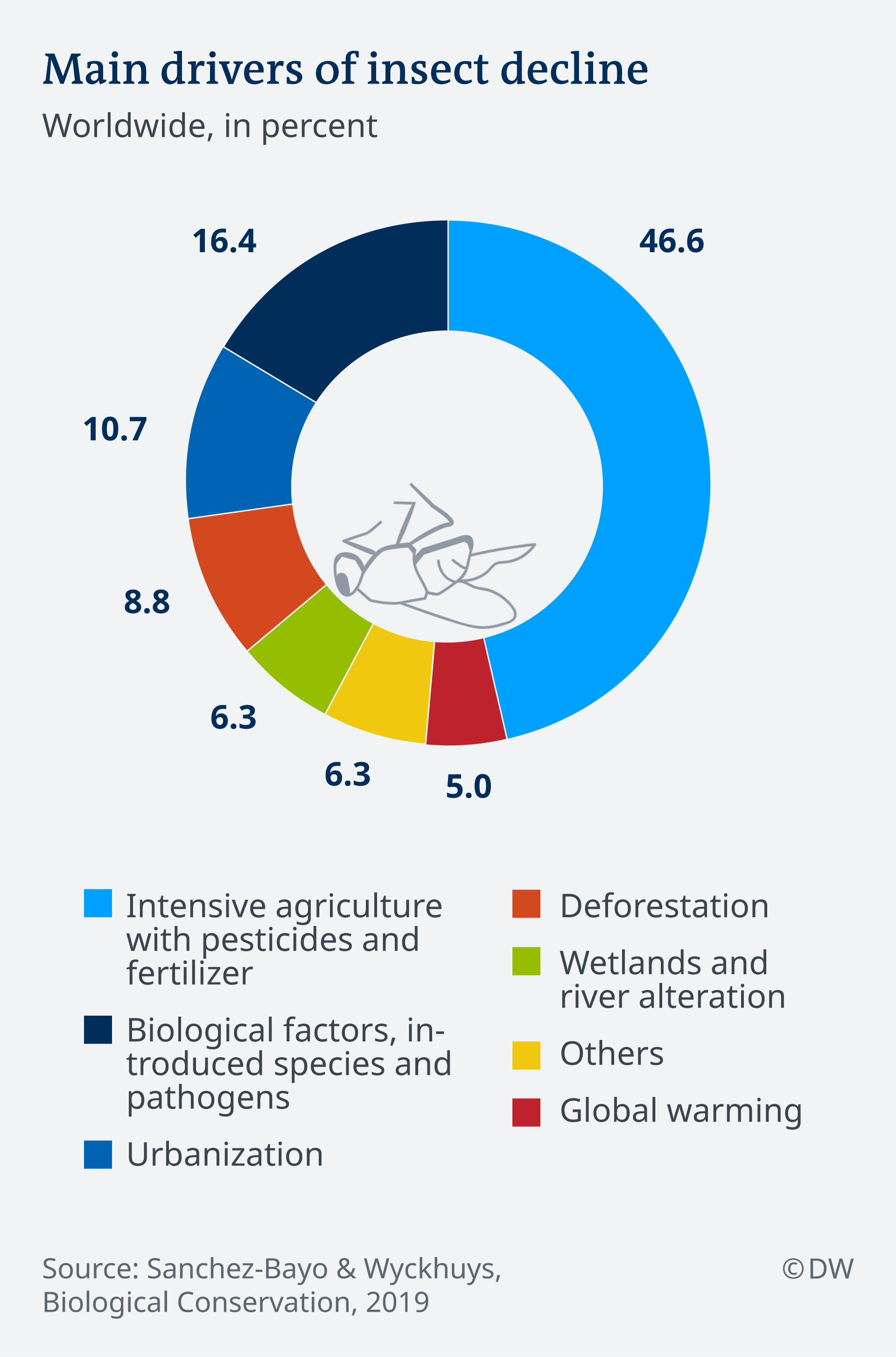
For insects, the top cause is agriculture (again). The first figure below is directly from Sánchez-Bayo and Wyckhuys. In the next one, someone merged some categories thematically.
I haven’t looked into sponges, cnidarians, worms and nematodes, mollusks, echinoderms, or arthropods besides insects. So…
Oh! Here: Since 1980 we’ve lost 48% of hard coral and “The UN’s climate panel has previously reported that at 1.5C of warming, coral reefs would decline by between 70% and 90%, and at 2C would be almost completely lost.”
etc. etc…
Notably, climate change is not yet a dominant factor, at least not for these phyla. This means that even if climate change stopped being an issue tomorrow, we’d still find ourselves in an elevated-extinction era.
Nevertheless, climate change is beginning to take its toll…
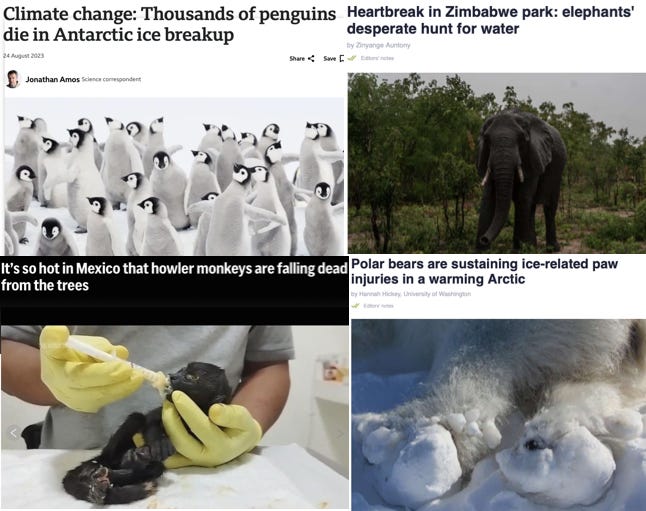
And we’re turning up the instability too quickly for adaptation to occur.
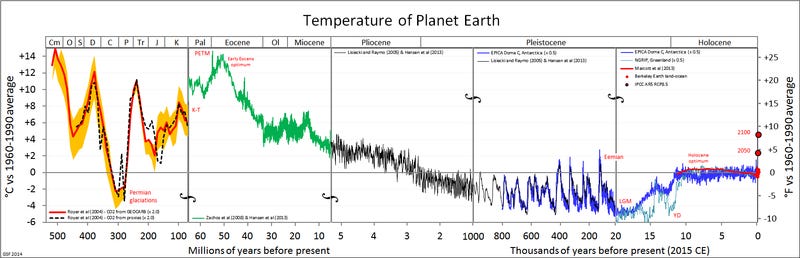

IIIV. THE ANSWER
So will this turn out to be a major mass extinction or not ❓I don’t know. As I’ve demonstrated before, I’m not averse to giving a grim prognosis. But in this case, it’s just too complex, and I’d be lying if I made a call either way.
Excellent command and analysis, as usual.
Peter Brannen wrote a book recently saying this does not yet qualify as the sixth major mass extinction, but to me these are mathematical quibbles. All of the causes of the horrific declines you cited are due to the actions of humanity, the life annihilator (though it's instructive from your post to see humanity is a piker compared to cyanobacteria in that regard).
The deaths of animal life due to human annihilation are surely on a planetary levels now, beyond our feeble attempts to mitigate or adapt to or comprehend. All human societies are annihilators, just on different scales and forms.
Try to see just one koala screaming (as in in one brief clip in the documentary "Greenwashed") as a human tries to put out its burns from human-induced habitat-destroying wildfires, and multiply it by all the animal deaths then and now caused by human ultrasocial predation. So many more to come, and nothing we, as a collective entity, can do about it.