

(apo)calyptic voices | 2. Not Applicable
This series looks at the distortion of collapse discourse toward acknowledgement that things are bad and could get worse, but without a grasp on what I would consider true collapsology - they don’t have a solid appreciation of “inter-realm dynamics and what they imply for the Werld”.
In my previous post, I wrote about the importance of determining which questions will provide the most relevant information, because (as far as forecasting goes) those data with the most “predictive weight” will provide a more accurate image of the future.
Here I’ll look at some examples of questions that might contribute some clues to our future - but people are interpreting them as being more meaningful than they are.
How Supposed Precedents Aren’t Really Parallels to Our Predicament
Examples from the past and from fiction can only tell us so much.
Previous civilizations’ collapses
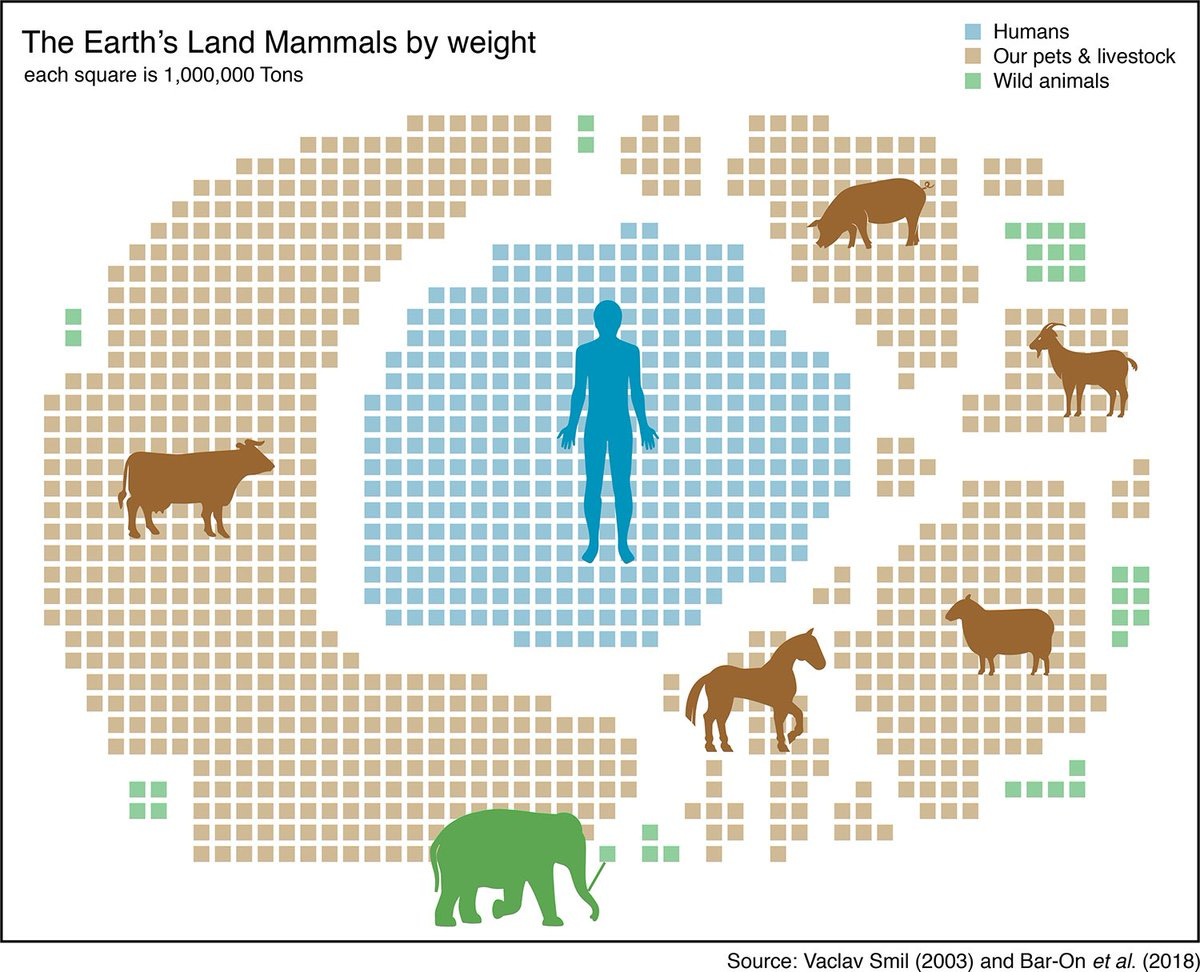
Inputs are much more depleted - Past societies, once they had stripped their surroundings of valuable material, could relocate to other regions. Now domesticated humans have spread across the global. There is no New World left undiscovered. We’ve degraded the soil in which we grow crop-plants for ourselves and for our livestock. We’ve devastated the populations of wild mammals and birds. As for fish, the “Will the oceans be empty by 2048?” section of this page explains that fishstock depletion could be worse - but I would venture that we won’t retain the technology to catch, preserve and distribute them at the current scale.
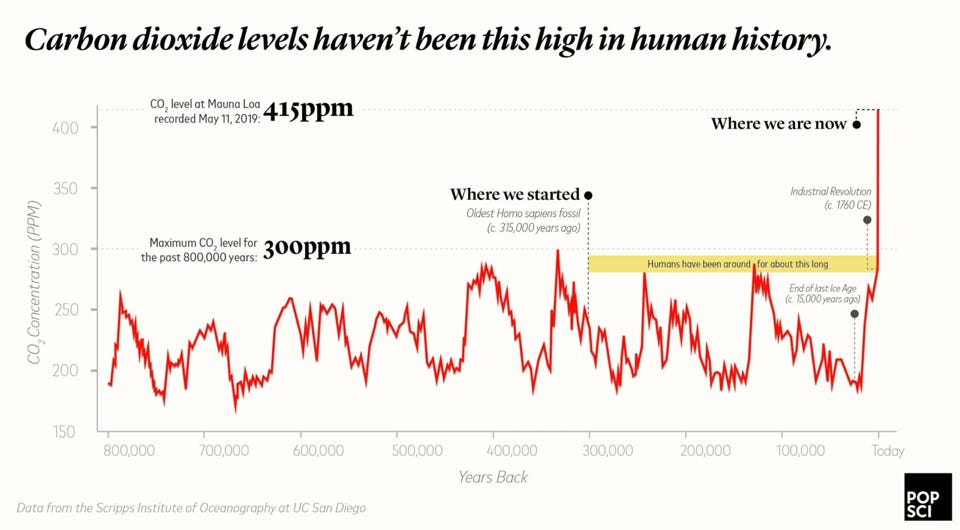
The pollution load is much heavier – Although previous civilizations destabilized their climates and released a slew of toxins, they hadn’t emitted as much carbon dioxide into the atmosphere as we have, or poisoned their water and soil with plastics, PFAs, nitrogen fertilizer run-off and pharmaceuticals, which (besides harming our own bodies) also disrupt other organisms’ biology/fertility and lead to antibiotic-resistant pathogens.


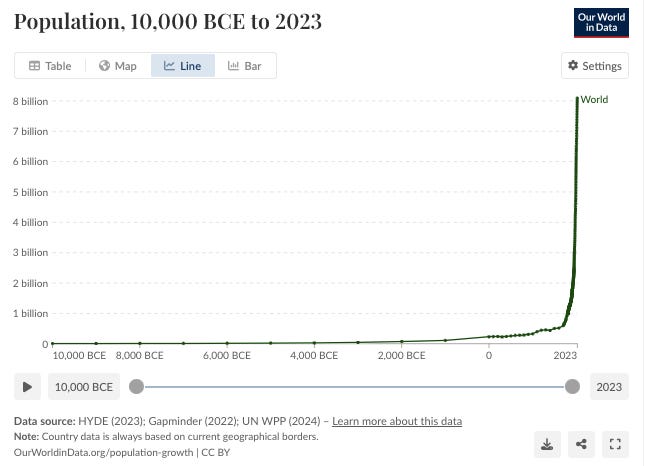
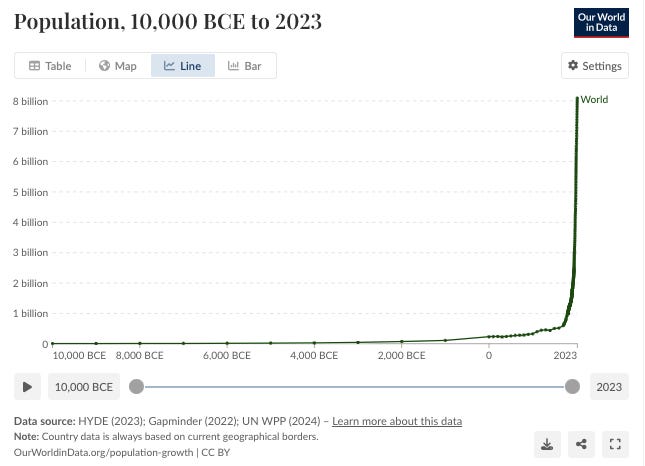
Operation Civilization’s participants are now more numerous - It’s not just that resource supply is much more depleted than before, but also that demand is and will be higher, at least for a while. This is a much greater altitude from which to fall.
source. so uhh…. Previous civilization members were more competent - At least 80% of earlier civilizations members farmed. In 1862, 90% of Americans were farmers. They were probably decent at foraging and hunting, too. Today, less than 2% of the USA’s population are officially farmers. The percent of Americans who grow (a least some) food has risen from 35% in 2013 to 43% in 2024. But will they be able to grow for subsistence?
Previous indigenous communities’ world-endings
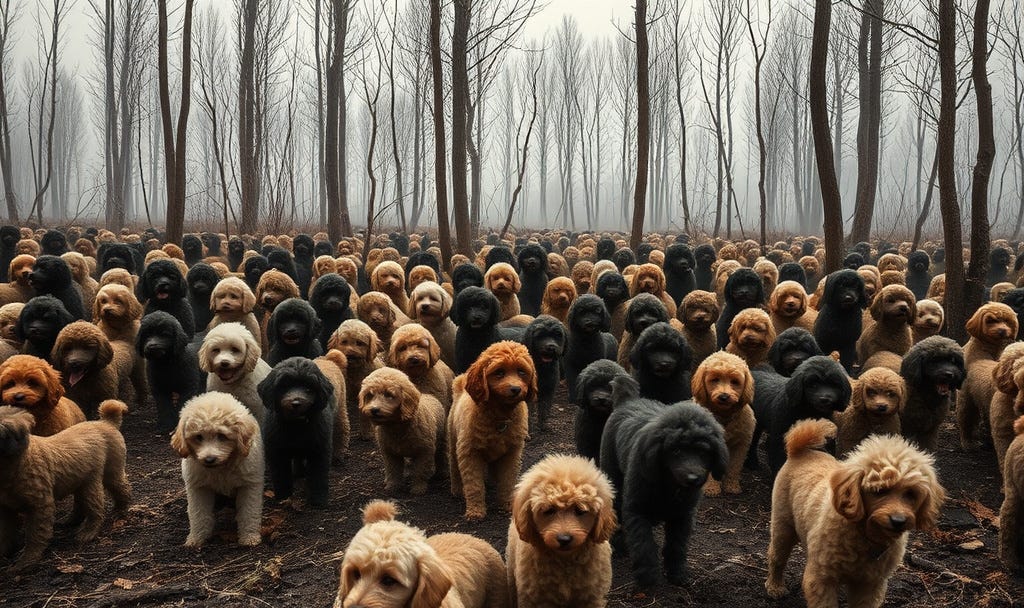
Speaking of competence - I’m definitely not as competent as the earlier human inhabitants of this continent. At the end of episode 115 of the Post Carbon Institute’s Crazy Town podcast, Alex Leff asserts that although “civilization as we know it … may be fundamentally unsustainable”, “humanity is not”. (I’m with him so far. I think a good portion of the 10 million humans who today live as hunter-gatherers have a decent shot.) He then suggests “Humans have lived without this high-energy lifestyle for a very long time; we can live without it again.” I wouldn’t assume that this “we”. includes someone like me or my neighbors or my would-be descendants. The fact that canine history involves 10 wolves in an intact forest does not prove that 8,000 poodles in a half-burnt forest will be okay.
In the Post-Carbon Institute’s Holding the Fire podcast, “Award-winning journalist and author Dahr Jamail hosts in-depth interviews with leaders from around the world to uncover Indigenous ways of reckoning with environmental and societal breakdown.” However, those instances were cases of the Werld’s assault on Earth (and on Earth-humans). There was a clear perpetrator. This time, it’s something that we’re doing to ourselves. The threat is us and how we’ve become accustomed to (shortsightedly) meeting our survival needs. It’s as inappropriate as Don’t Look Up’s comet metaphor. The better analogy would be cyanobacteria gassing everyone and itself.
Furthermore, many indigenous people didn’t survive their “apocalypse”. Hearing from descendants of survivors might be a case of Survivorship Bias. It would be at least as relevant to examine the experiences of those whom Europe’s invasion killed, and use this as a basis for our expectations.
Previous fossil fuel cut-offs
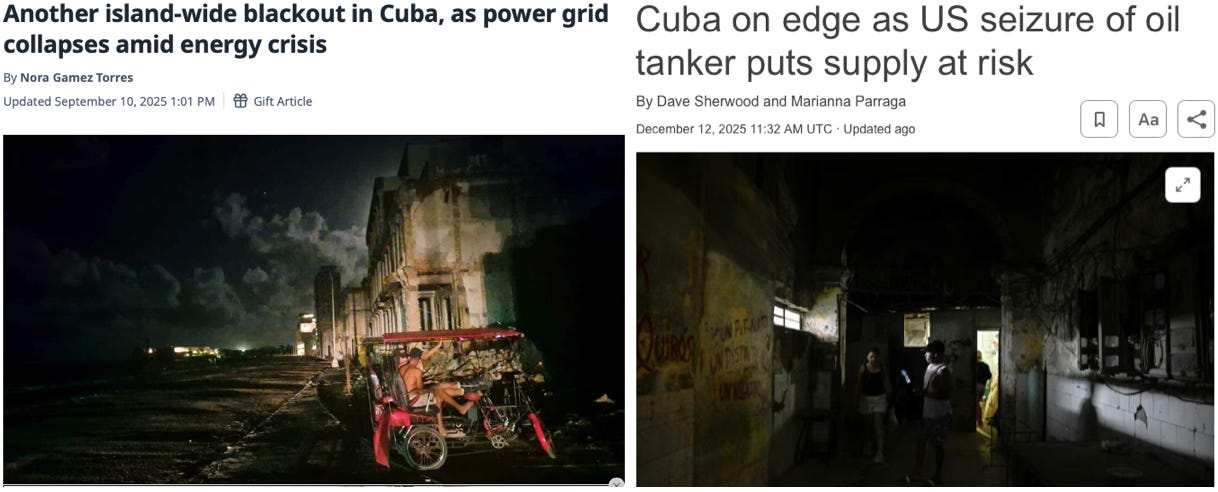
When in the 2000s, Americans started worrying about Peak Oil, they pointed to how Cubans pulled together in the 1990s. There’s even a documentary about it, The Power of Community.
Fast forward to 2025, and this glimpse of contemporary life in Cuba notes that “seven in 10 Cubans have skipped breakfast, lunch, or dinner due to lack of money or food shortages, while nearly 89% of the population currently lives in extreme poverty.” Where are the community gardens, saving the day? Something has changed. And if 1990s-Cuba isn’t a perfect predictor of 2020s-Cuba, we can’t assume that it reveals what 2030s-USA looks like.
Nations that have faced a downturn
A common refrain in the collapse-aware community is, “The future is already here—it’s just not very evenly distributed,” a sarcastic take on science fiction author William Gibson’s observation about technology. But it would be a mistake to take countries like Venezuela as an example of where collapse will stop. Venezuela may be farther along than other countries in its collapse but it isn’t done. There inevitably lies ahead a future when all of the Werld is complete gone and Earth is fully rewilded. Therefore, as long as any Werld remains, the other shoe has yet to drop.1

Fiction
One big way in which many post-apocalyptic scenes are misleading is they feature very few human survivors. For the next few decades, there will be plenty of other humans around you, experiencing the same infrastructure breakdown, product shortages, disease, conflict and existential crisis.
Furthermore, science fiction is by definition high-tech whereas our future will be low-tech. This would change a lot about the plot.
Fiction is free to omit many details and not be held accountable. Tom Murphy has written about how our acceptance of video game “fizix” now influences what we believe is possible in real life.
Previous fights for better conditions
In Abolishing Fossil Fuels, Kevin Yong points to winning strategies in “four classic victories”: the abolition of slavery, battles for workers’ rights in the 1930s, Black freedom struggles of the 1950s and 1960s, and the fight for clean air.
Granted, some Werld-humans now enjoy better circumstances and we don’t emit certain gasses as much. But in all four cases, the Werld continued to wage its war on Earth. Targeting fossil fuels is a very different battle because it really does threaten the Werld’s core operative.
Previous natural disasters
I’m referring to Rebecca Solnit’s “A Paradise Built in Hell” … and I’ll cover this in my next post.
Technology adoption trends
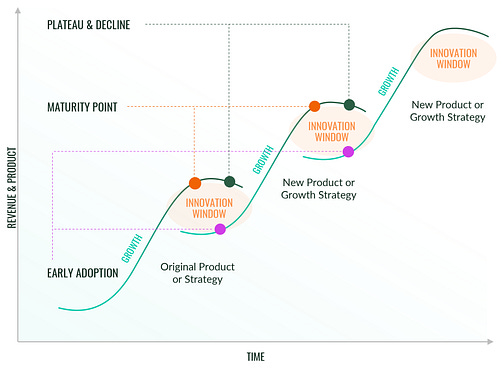
One thing that we might be getting wrong is our assumption that the “S-curve” of tech adoption applies to how “clean” energy will proliferate. (I can’t find my source for this idea, but it was a guest on The Great Simplification podcast. Male, not American, probably in 2023-?) “Clean” energy uptake is more accurately considered infrastructure, with the familiar setbacks and delays that “development” faces.
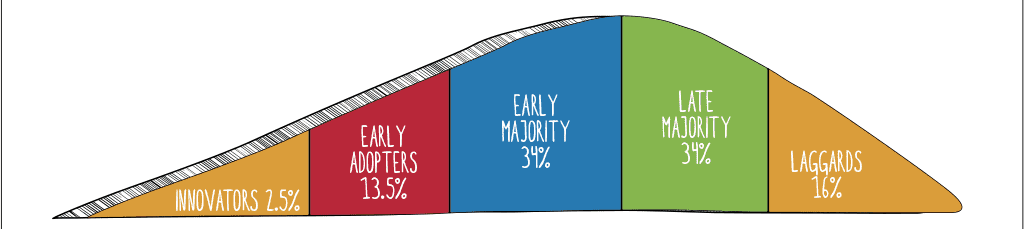
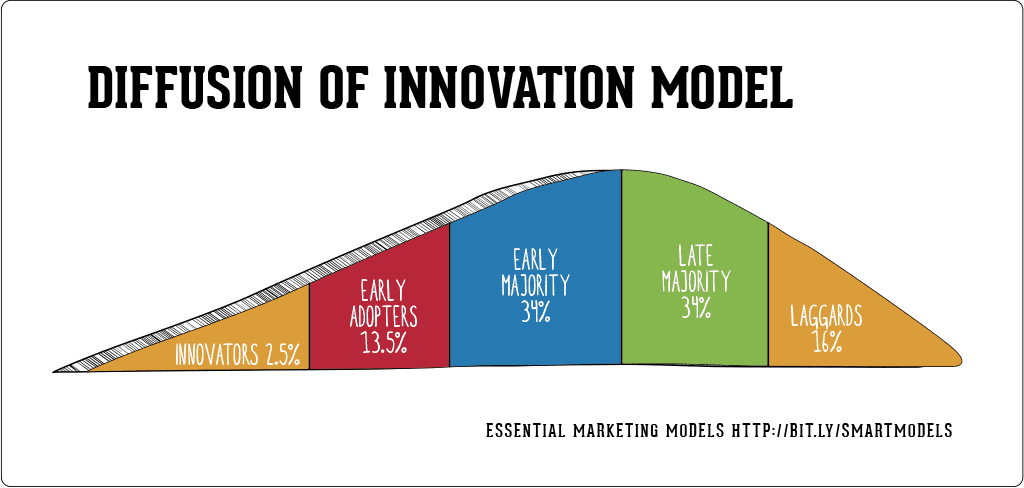
People also refer to Everett Rogers’ “diffusion of innovation model” when speaking about resilience behaviors. However, I’d argue that a flashy new trend faces fewer psychological barriers to adoption than does the dread-inducing realities that motivate someone to invest in resilience. So the distribution across time might not look as it is typically portrayed.
Other Data That Can’t Serve as Strong Clues
These are questions that I’ve noticed people investing in, as if they can serve as guides to bigger-picture questions of “What’s happening? Why? What will happen?”
I’ve actually introduced some myself, in past posts. For example, the answer to “Is Earth experiencing a major mass extinction?” -whether it’s yes or no- hardly provides information about what your lived experience will be over the next few years and decades - if that’s what you’re interested in knowing. And I think that is what most people are actually wondering. Regardless of extinction rates, planetary events could still dramatically alter your lifestyle. Similarly, when we talk about humans going extinct, we create two false extremes: totally eradicated or totally fine. This overlooks, for example, a realistic scenario where our population falls from 8+ billion in 2025 to less than 1 billion in 2100, which would be pretty disruptive to our routines.
There’s no right answer to the wrong question.
-Ursula K. LeGuin
Is electricity getting cheaper?
I explain in my Post #5.3:
Prices are another distraction from the bigger picture of “humans exploiting the planet at a rate that will be impossible to maintain (and wreaking havoc on all other lifeforms in the process)”.
We’re building “green” infrastructure from materials that exist in finite supply, so the overall trajectory is toward reduced availability. If I have a pile of 10 rocks, and on Monday I offer you 1 rock, and on Tuesday I offer you 3, then you might celebrate the rock supply’s expansion and its impact on the market: lower prices! You won’t pay attention to the depletion of rocks-yet-to-be-accessed, from 10 to 9 to 6… Headlines about falling solar panel prices create the same temporary illusion.
Are electric vehicles environmentally-friendlier than internal combustion engines?
This is one of 50 questions that Hannah Ritchie (to whom -according to her book cover- Bill Gates turns when feeling overwhelmed) addresses in her 2026 book, “Clearing the Air: A Hopeful Guide to Solving Climate Change in 50 Questions and Answers”. I think this is besides the point. I’d ask, “As diesel is goes into decline, will society be manufacturing cars of either kind? Is that even the most pressing issue under those circumstances?”
Can we stay below 1.5C?
This is important information for Earth, but the Werld is a lost cause (as I’ve explained before) regardless of the temperature. There is no “window of opportunity” for the Werld to secure eternal reign. From the moment the Werld emerged, it was always “too late” to avoid its eventual end.
Does capitalism bring out the worst in us?
Sure. The mere sight of money can make us antisocial.
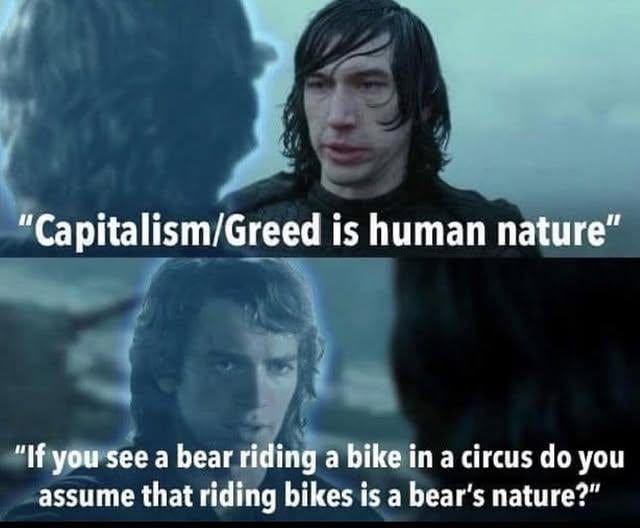
Better question: When the circus goes away, will the abandoned bear who spent his whole life riding a bike know how to forage as his new normal? When there’s no diesel to bring you food, will you know how to feed yourself?
Is enshittification avoidable, theoretically?
(Cory Doctorow appeared on the Team Human podcast to discuss this.) Sure, but will you even be able to power factories? In Post #2.2, I’ve documented several cases where Earth has forced shutdowns and she’s just getting started.
Could organic feed as many as conventional, theoretically?
This study found that organic farming practices can produce 81.6% as much food as conventional methods. More importantly, beyond the vacuum of hypotheticals - How many people will be putting in the labor to make this happen? How far will we be able to transport the food from where it grows?
How much meat is “sustainable”, theoretically?
I think a better way to anticipate future meat availability is to consider the ways in which we’re currently keeping the supply artificially high. For example, we pump loads of antibiotics into livestock in Concentrated Animal Feedlot Operations and stave off the spread of flesh-eating screwworm by breeding sterile mates and releasing them from airplanes. Will we be able to keep up those measures and many others? Drought cost Iraq 70% of its livestock last year.
Did Gavi and UNICEF secure a deal to cut the price of the R21 malaria vaccine by 25%? Did Brazil launch a new Tropical Forest Forever Fund? Did a team of humans reintroduce a few hundred of Europe’s heretofore-extirpated keystone vulture species who “stabilises food webs, limits disease and signals the revival of functioning ecosystems”?
Yes, yes and yes. AND the industrial-digital system that meets our essential needs is expiring, inevitably. AND, the longer the industrial-digital system operates, the more it spews greenhouse gas emissions that disrupt our climate and toxic chemicals that cause cancer and infertility, rendering narrow biodiversity efforts ineffective.
(Inspired by the “Fix the News” substack - “fix” in the sense of “manipulate”, maybe.)
Beyond cities, does one find fewer jobs, shoddier public transportation, and diminished access to culture and essential services?
Yes, yes and yes. AND the industrial-digital system that meets our essential needs is expiring, and will therefore making survival in concrete jungles very difficult.
(Inspired by a post from the “Terrenity” substack. Also, I can’t help but notice the ironic tension between her title “Build the Village, Starve the Empire” and the depiction of urban gardening. In which direction must material resources flow for urban gardens to expand? Who’s imperializing, then?)
Could we theoretically have non-industrial medicine?
Sure, if everything else were going pretty splendidly. But I don’t currently see this emerging in countries where breakdown is farther along (an overview is in Post #2.3). The belief that “we” (clearly they aren’t pulling it off so … “we” = more “developed” nations?) could make this work seems to be based on the assumption that we’ll be able to handle climate chaos, toxins and energy/supply shortages better than others are. Are we really wiser, more skilled, more resilient? Or are we fighting over novelty Starbucks paraphernalia?
Are people in Silicon Valley meditating more?
On an episode of Accidental Gods, host Manda Scott shares:
“I was listening to Nate Hagens relatively recently and he was talking to someone in the AI world, tech world, tech bro world, who said that five years ago if he’d gone to a dinner party and told people that he meditated, they would all looked at him like he had horns. And now if he went to the same dinner party and told people that he didn’t meditate, they would look at him like he had horns. And so something is shifting and and we are all aware that simply sitting on a cushion observing your breath does not necessarily turn you into a decent human being. And there’s a lot of other inner work to be done, but at least it’s a step on the way. And it seems to me that there’s an accelerating pace of change.”
Sure, and it’s possible -nay, probable- that Werld-humans will struggle to adapt to fossil fuel decline and climate weirding, and suffer immensely.
Do you have kids?
Sarah Wilson had as a guest on her podcast, Wild (a podcast that openly discusses civilization collapse), “Rich from Ohh That’s RICH”.
“…but I also have two young children and so I have to believe that this country has a future that’s not going to be dystopian and I choose to believe that because I personally refuse to have it any other way and I’ll do whatever I can to protect it”
The Werld has been imposing dystopia on all other Life. As the human supremacist reign comes to an end, circumstances are going to be pretty harsh on Rich (and on his kids) regardless of whether he refuses to have it that way.
Do we understand better than ever what’s causing this?
I’ve noticed many nature documentaries end this way.
But, technically, few humans do truly understand what’s causing this - in the sense that they fail to understand that there is no loophole for civilization.
And even if we did understand, awareness doesn’t guarantee wise action. In my Post #3.2, I look at how society at-large is fairly locked into doing the stupid thing.
Is “collapse” going mainstream?
During this conversation in April 2025, “Acceptance and Agency at the End of Modernity”, Vanessa Andreotti notes that…
“Before January, many people would ask me ‘What’s the evidence that modernity is dying?’ or sometimes ‘What’s the evidence that it’s violent?’ … But I have not been asking this question since January.
Granted, she does then admit that liberals (progressives) want to keep modernity on life support.
Nevertheless, I don’t think the fact that Werld-humans are feeling as if their world is ending (or that the Guardian ran “The Armageddon complex” series) is equivalent to anyone understanding that the Werld has a fundamentally disharmonious relationship with Earth and therefore a necessarily short tenure.
Random replies to a grab-bag of a post:
I had trouble following the outline. Two sections - Truly Unprecedented and "Proxy Questions," though some subheadings didn't feel to me to match up with their respective sections.
I.3 - I thought: Also, many of these participants use such a volume of resources, probably way more than participants from the past! Double whammy.
Survivorship Bias - I took a different lesson from a couple of stories that came to mind as I reflected on this section. (see https://www.resilience.org/stories/2023-12-12/holding-the-fire-episode-11-lyla-june-johnston/ or see https://forthewild.world/listen/enrique-salmon-on-moral-landscapes-amidst-changing-ecologies-225) (AND: 800 poodles in a half-burnt forest - LOL touche!)
Fiction - I had not quite formulated the idea / recognized that so much post-apocalyptic fiction has so few people. An A for this one (https://x.com/DefenderOfBasic/status/1984832854124052502?s=20) ... the reality of lots of incompetent people violently bouncing off each other in a messy low-tech world sounds correct ... maybe it's not as fictionally compelling is why it's uncommon?
Diffusion of Innovation Model! An A for this one too. Entertaining oneself with a fun and diverting new gadget versus mucking about in the dirt trying to grow potatoes to be more self-sufficient? Duh, yes.
Lastly, I'm here for any and all Ursula K. LeGuin content!
These people, like Rutger Bregman (also on TGS), who can make themselves say sentences like “I choose to believe in a fairy tale because I have children” - do they even hear themselves?
They’re maintaining plausible deniability towards themselves, is what they are doing. They refuse to face the truth they know because it’s too painful. It makes sense in plenty of ways.
The poodle scenario is apt. I recently asked a prepper if her community had plans for what to do when hundreds of people come begging for food. They do not.
Re sci-fi, the dystopian kind isn’t shy about envisioning bad ends. The Road is a decent take on what’s in store for us all somewhere down the line.